

CHAPTER 2:
Peering Behind The Mask.
CHAPTER 2:
Peering Behind
The Mask.
There’s a reason ancient civilizations spent centuries mapping the sky instead of, I don’t know, resting. They understood something we’ve largely forgotten in the age of daily horoscopes: that the exact configuration of the sky at the moment you were born never happens the same way twice. Not that day, not that year, not for another 25,000-plus years if you’re accounting for the full precession cycle.
And what you’re about to look at isn’t some generic astrology graphic. It’s yours. Only yours.
FALLBACK, Here is Your birth chart:
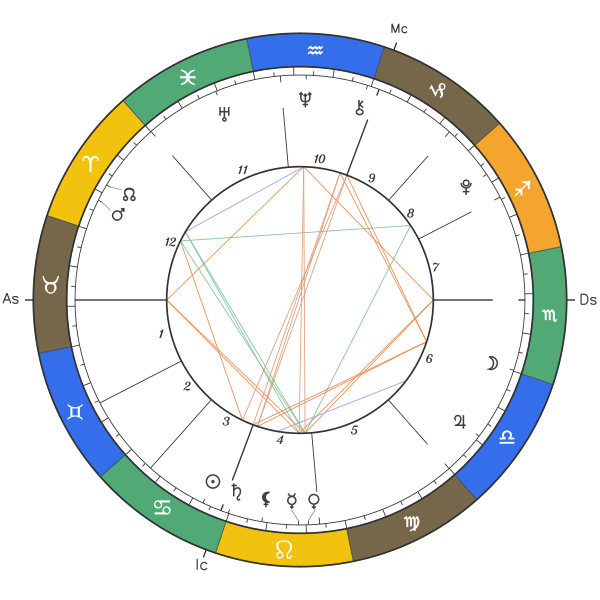
It has been calculated based on the precise moment you were born at FALLBACK as well as your exact place of birth, FALLBACK.
I know it probably looks like a lot right now — a circle full of glyphs, lines cutting across each other, symbols that look more like they belong in a physics textbook than something meant to describe your personality. Stick with me. Every single line, every division, every planet sitting in its specific spot is doing something. This chart is essentially a snapshot of the entire sky at the exact minute you took your first breath — where every planet was, what sign it was passing through, and which part of your life it was quietly going to influence for the rest of your time on this planet. It sounds dramatic because it is dramatic. This is, genuinely, one of the closest things we have to a blueprint of a person.
And that’s exactly what we’re going to spend this reading doing — decoding it, piece by piece, until what looked like a complicated diagram starts to look a lot like… you. The parts of you that make sense to you already, and honestly, the parts that probably never have.
Just to give you a taste of what’s coming: later in this reading, I’m going to show you where your Mercury sits, and I think it’s going to reframe the way you think about how your mind actually works — why you process certain things at lightning speed and others feel like wading through mud. I’ll show you where Venus and Mars are sitting, which is going to tell us a lot about the push and pull in how you love and how you fight for the things you want. There’s a placement in there that explains a pattern I’d bet you’ve noticed in yourself but never quite had language for. We’ll get there.
But every good decoding starts with the fundamentals, and that’s what this chapter is about. Before we go deep into the specific, granular placements, I want to slow down and cover the three placements that essentially form the skeleton of your entire chart — the load-bearing walls, if you want to think of it that way. Everything else we uncover later gets built on top of these three.
I’m talking about your Sun, your Moon, and your Rising sign.
Here’s the thing about your Sun sign that most people get wrong: knowing you’re a FALLBACK tells me something, sure, but it doesn’t tell me everything, not even close. There are millions of FALLBACK walking around right now and they are not all the same person wearing different faces. Your Sun is your core, your essential energy, the thing driving the bus — but it’s filtered through everything else in your chart, which is why two FALLBACK can look almost nothing alike. FALLBACK, by the time we’re done with this chapter, you’re going to understand why “you’re just being a typical FALLBACK” has never quite captured the full picture.
Then there’s your Moon, which honestly might end up being the placement that resonates with you the most, because this is the part of you that doesn’t perform. Your Sun is who you’re becoming, who you present, the version of you that’s a little more conscious and deliberate. Your Moon is what’s happening underneath that — your gut reactions, what actually makes you feel safe, what you need when things fall apart and nobody’s around to see it. It’s less about who you are on a stage and more about who you are at 2am when you can’t sleep.
And finally, your Rising sign — or Ascendant — which is arguably the most misunderstood placement of the three. This is the mask, quite literally. It’s the energy you’re radiating before you’ve said a single word, the vibe people pick up on in the first few seconds of meeting you, which — and I cannot stress this enough — is not always in agreement with your Sun or Moon at all. Sometimes it’s a near-perfect match. Sometimes it’s almost a contradiction, and that gap is usually where a lot of the “wait, you’re actually nothing like I expected” comments come from.
The Truth About YOUR FALLBACK NATURE.
Every zodiac sign spans 30 degrees of the sky, and that 30 degrees gets split into three equal chunks of 10 degrees each, which we refer to as “decans.” In other words — your Sun sign tells you the genre, but your decan tells you the specific plot. Which is why two people can both proudly claim “FALLBACK” and still seem like they’re operating on completely different frequencies.
8A. SCORPIO DECAN 1
And since your birthday falls roughly between October 23rd and November 1st, this means you have the most concentrated dose of Scorpio there is. No dilution, no softening from a neighboring sign’s influence. Just pure, undiluted Pluto and Mars running the show, and if you’ve ever had someone tell you that you’re “intense” within the first ten minutes of meeting you, that’s not a coincidence. That’s just Tuesday for you.
Here’s what makes your decan different from the other two: all three decans of Scorpio are ruled by Scorpio itself in terms of core identity, but the sub-rulers shift the flavor. Yours gets doubled down on by Mars and Pluto simultaneously, which basically means you got Scorpio at its most concentrated. Mars gives you the drive, the edge, the willingness to go to war for what matters. Pluto gives you the depth, the obsession, the ability to sit in darkness that would send other people running for the light switch. Put those together and you get someone who doesn’t really do “casual.” You do all-in or you do nothing.
You’re the reason people say Scorpios are “too much.” You’re not too much. You just refuse to exist at half-volume, and that makes people who are used to surface-level everything a little uncomfortable. You ask the questions other people are thinking but too polite to say out loud. You notice when someone’s lying before they’ve finished the sentence. You feel things at a depth that genuinely surprises people who only know the version of you that seems controlled and unreadable on the outside — because that’s the trick with you, isn’t it? Everything’s happening beneath the surface, and very few people ever get invited down there.
That instinct to guard the depths isn’t paranoia, even though it might get mistaken for it. It’s pattern recognition. Somewhere along the way you learned that not everyone deserves the real version of you, and instead of resenting that lesson, you built an entire operating system around it. You watch. You test. You wait to see what someone does under pressure before you decide how much of yourself they get access to. It’s not that you don’t trust people — it’s that you trust your own read on people more than you trust their words, and honestly, your read is usually right.
The flip side of that laser-focused intensity is that when it turns inward, it turns into something a little heavier. You don’t just feel your emotions, you excavate them. A regular person has a bad day and moves on by dinner. You have a bad day and you’re still turning it over in your head a week later, looking for what it meant, what it revealed, what it’s trying to teach you. This makes you someone who genuinely grows from hard experiences instead of just surviving them — but it also means you can get stuck in your own head in a way that’s exhausting, replaying conversations, picking apart interactions for hidden meanings that may or may not actually be there.
You also have a complicated relationship with control, and this isn’t a flaw so much as a scar with a purpose. When you were younger, something likely happened that taught you the cost of being caught off guard — of trusting the wrong person, of being blindsided by a betrayal you didn’t see coming. Ever since, you’ve operated with a kind of quiet vigilance most people never clock because you’re good at appearing calm on the surface. But underneath, you’re always tracking. Who’s being genuine. Who’s hiding something. Who’s about to disappoint you before they even know it themselves.
Where you really shine is in your capacity for transformation. You don’t just experience endings — you use them. Most people cling to what’s familiar even when it’s clearly not working anymore. You have this rare ability to burn something down completely and rebuild from the ashes without flinching, whether that’s a relationship, a career, or a version of yourself you’ve outgrown. It’s not that endings don’t hurt you — they do, deeply — it’s that you have an almost mythological relationship with reinvention. You are, quite literally, built to come back from things that would permanently break other people.
If there’s a lesson threaded through your chart, it’s learning when to let the walls down before someone has to prove themselves worthy of it a hundred times over. Your instincts are sharp, but not every closed door needs a deadbolt. Some people are actually just standing there, waiting to be let in, and the intensity that makes you so magnetic is the same intensity that can make real intimacy feel like a risk not worth taking. You don’t need to soften who you are. You just occasionally need to remember that not every wall needs to be quite that thick.
8B. SCORPIO DECAN 2
And since your birthday falls roughly between November 2nd and November 11th, you belong to the second decan of Scorpio — the one where Pluto’s intensity gets filtered through the Moon’s watery, emotional undercurrent, thanks to Cancer stepping in as your sub-ruler. This doesn’t make you any less Scorpio. If anything, it makes you the most emotionally saturated version of the sign — the one where the sting isn’t just strategic, it’s deeply, achingly felt.
Here’s what separates you from the other two: decan one runs on raw Mars-Pluto war, all instinct, force and confrontation, while decan three lets Neptune blur Scorpio’s intensity into intuition, sensitivity and emotional merging. You sit between them. You’ve got the same Plutonian undercurrent, but the Moon threads something else through it — memory, nostalgia, an almost bottomless well of feeling that makes you less like a scorpion poised to strike and more like the ocean at night: still on the surface, but capable of pulling anything under without warning. Where decan one strikes and decan three absorbs, you remember. You don’t just feel intensely. You carry what you feel with you. Every slight, every tenderness, every moment someone showed you who they really were — it’s all filed away somewhere, and very little of it ever fully fades.
You’re the reason people assume Scorpios are secretly soft underneath all that armor. You are. That’s not a weakness, even if it sometimes feels like one. The Moon in your decan means your emotional memory runs deeper than almost anyone else in the zodiac, and it means you experience your own history — your childhood, your family, your earliest wounds — as something alive, still shaping the way you move through the world today. You don’t leave things in the past. You carry them, examine them, sometimes protect them like relics. That instinct to hold on isn’t sentimentality for its own sake — it’s how you make sense of who you’ve become.
That emotional memory is also what makes you so good at reading rooms, reading people, reading the exact moment when someone’s mask slips. You’ve likely been called “eerily perceptive” more than once, and it’s because you’re not just watching people the way decan one does — you’re feeling them, absorbing the emotional temperature of a space before a single word gets said. This can be a superpower. It can also be exhausting, because you don’t just pick up on the good stuff. You absorb the tension, the unspoken resentment, the thing someone’s not saying but is radiating anyway — and then you carry that home with you too.
The flip side of all that emotional depth is a tendency toward moodiness that can genuinely surprise the people around you, especially if they only know your controlled, unreadable Scorpio exterior. You can go from steady to stormy in what feels like seconds to everyone else, but to you, it’s never sudden — it’s the slow accumulation of something you’d been quietly holding onto, finally breaking the surface. You don’t do small emotional shifts. When the tide turns in you, it turns all the way.
You also have a complicated relationship with security, and this isn’t random — it’s rooted in something that runs all the way back to your earliest sense of home. Somewhere in your history, you learned that emotional safety wasn’t something you could take for granted, and ever since, you’ve been building your own version of it — quietly, privately, sometimes in ways nobody else even notices. You crave closeness, real closeness, but you test it constantly, because a part of you is always bracing for the moment the ground shifts again. It’s not mistrust. It’s muscle memory.
Where you truly excel is in your capacity for emotional loyalty. Once someone earns their way past your defenses, you don’t love them halfway — you fold them into your inner world completely, remembering their history the way you remember your own, protecting them with a ferocity that borders on maternal even when you’re the furthest thing from soft on the outside. People who’ve had you in their corner during a crisis know this about you already: you don’t disappear when things get hard. You dig in. You nest around the people you love, even in the middle of chaos.
If there’s a lesson written into your chart, it’s learning that not every emotional wound needs to be relived to be honored. You have an incredible gift for feeling deeply and remembering fully, but sometimes that gift turns into a trap — replaying old hurts long after the people who caused them have moved on, holding onto emotional weather systems that don’t need to be carried anymore. You don’t need to feel less. You just occasionally need permission to let a feeling complete itself instead of keeping it alive forever, just to make sure it still means something.
8C. SCORPIO DECAN 3
And since your birthday falls roughly between November 12th and November 21st, you belong to the third and final decan of Scorpio — the one where Pluto’s intensity gets filtered through Neptune’s dreamy, boundaryless influence, thanks to Pisces stepping in as your sub-ruler. This doesn’t dilute your Scorpio nature. It mystifies it. You’re the decan where the sting turns psychic, where the depth turns spiritual, and where “intense” starts to look a lot more like “otherworldly.”
Here’s what separates you from the other two: decan one runs on raw Mars-Pluto war, decan two carries Cancer’s emotional memory. You’ve got the same Plutonian undercurrent, but Neptune dissolves the hard edges into something far less literal. You don’t just sense when someone’s lying — you sense what they’re not even consciously aware of yet. You don’t just feel your own emotions deeply — you feel other people’s, absorbing them like water takes the shape of whatever container it’s poured into. Where decan one strikes and decan two remembers, you merge. You dissolve the line between yourself and whatever — or whoever — you’re paying attention to.
You’re the reason people say Scorpios are “psychic” or “spooky accurate” about things they have no business knowing. You are, and it’s not a party trick. Neptune in your decan means you pick up on things through channels most people don’t even know exist — a feeling in a room, a dream that turns out to mean something, a gut sense about a person that takes months to be proven right. This makes you the most intuitive decan of the entire zodiac, but it also means your inner world can get genuinely blurry. You struggle more than most to tell the difference between what’s actually happening and what you’re afraid might be happening, because your imagination and your perception are wired from the same source.
That heightened sensitivity is also why you’re drawn to art, mysticism, music, or anything that lets you express what words can’t quite reach. Scorpio gives you the depth. Neptune gives you the language for it — symbolic, poetic, sometimes more honest in metaphor than you’d ever be able to manage in plain speech. You’ve probably surprised people with how easily you can put something devastatingly accurate into words, or a song, or an image, when you could never have said it directly in conversation. Your soul speaks fluent subtext.
The flip side of that boundaryless empathy is a tendency to lose yourself in other people, or in feelings that were never entirely yours to begin with. You can walk into a room steady and walk out completely rearranged by someone else’s chaos, because your natural instinct is to absorb rather than deflect. This makes you deeply compassionate — genuinely, rarely-matched compassionate — but it also means you need more alone time than you probably admit to, just to figure out which emotions in your body actually belong to you.
You also have a complicated relationship with escape, and this isn’t a character flaw so much as a survival skill you built early. Somewhere along the way, reality got heavy enough that you learned how to leave it — through daydreaming, sleep, creative obsession, spiritual searching, or sometimes substances or relationships that let you dissolve into something bigger than yourself. This isn’t weakness. It’s Neptune doing what Neptune does: offering you a door out when the world gets too sharp-edged for your particular nervous system. The work is learning which doors lead somewhere real, and which ones just numb you long enough to avoid the thing underneath.
Where you truly excel is in your capacity for transcendence. You don’t just heal from pain — you transform it into something sacred, something meaningful, sometimes something that helps other people heal too. Your instinct is to find the divine thread running through even the darkest experiences, to locate meaning where other people only see wreckage. People come to you when they’re falling apart because something about you makes suffering feel less like an ending and more like an initiation into something deeper.
If there’s a lesson threaded through your chart, it’s learning to keep one foot on solid ground even while the rest of you swims in deeper waters. Your gift is dissolving boundaries — between self and other, between the seen and unseen, between what’s real and what’s felt. But not every boundary is meant to be dissolved, and not every wave that moves through you is actually yours to carry. You don’t need to become less porous to the world. You just occasionally need an anchor, so the depths you’re so at home in don’t end up sweeping you out too far to find your way back.
Your Moon Sign Sits In FALLBACK.
Your Sun sign often gets all the attention, but your Moon is the one doing most of the emotional work.
If the Sun describes the person you’re consciously becoming — your identity, your drive, the version of you that shows up when you’ve had a moment to prepare — the Moon describes what’s going on underneath while all of that is happening. It’s your emotional reflex. Your instinct. It rules what you need in order to feel steady, how you soothe yourself when nobody’s watching, and who you are in the first three seconds after bad news, before you’ve had time to arrange your face.
The Sun is who you are in the room. The Moon is who you are when the door closes.
And for you, FALLBACK, your Moon sign sits in FALLBACK.
1/12. moon sign: ARIES
There’s a speed to the way you feel things. Not shallowness — speed. Your Moon in Aries means emotion tends to arrive in you fully formed, already at temperature, before you’ve had a chance to decide whether you wanted it. Other people describe “working out how they feel.” You often don’t get that interval. The feeling is simply there, and then you’re managing it, or acting on it, or trying to look composed while it burns off.
This gives you a kind of emotional honesty that’s rarer than you think. With an Aries Moon, you’re not particularly good at performing a feeling you don’t have. You may have noticed that your face gives you away, or that your tone shifts a half-second before you’ve consciously registered irritation. People who know you well can often read you instantly. People who don’t sometimes find you disarmingly direct — you’ll name the thing in the room that everyone else was politely working around, and you’ll do it without much sense that you’ve taken a risk.
What’s less visible is how much that immediacy costs you. There’s a part of you that reacts first and then has to live with the reaction. You may know the specific feeling of replaying something you said — not because it was untrue, but because it came out at full volume when half would have done. Your Moon in Aries can make the gap between feeling and expression very narrow, and the aftermath is where you do most of your emotional processing. You’re rarely regretting the substance. You’re regretting the velocity.
The strange contradiction here is that you often recover long before the other person does. Your anger tends to burn hot and clear out fast, which means you can be genuinely finished with a conflict twenty minutes after it happened, ready to move on, faintly baffled that someone else is still holding it. This isn’t callousness — you’ve actually processed it. But it can read that way from the outside, and you may have been accused of not taking things seriously when the truth is you took them extremely seriously for eleven intense minutes and then arrived at the other side.
One thing you don’t always show people is how much you need to feel like you’re the one moving. Your Aries Moon takes comfort in agency, not in stillness. When something goes wrong, the instinct isn’t to sit with it — it’s to do something about it, immediately, even if the something is imperfect. Waiting is genuinely harder for you than acting badly. This is why situations where you’re powerless — a slow diagnosis, someone else’s decision, a relationship where you’re waiting to be chosen — hit you far harder than crises where you have a role to play. You can handle enormous difficulty. What corrodes you is having nothing to push against.
There’s also a vulnerability here you may protect fairly carefully. Feeling things quickly means feeling hurt quickly too, and with an Aries Moon the first response to being wounded is very often something that looks like heat rather than something that looks like pain. Sharpness, impatience, sudden withdrawal, a joke with an edge on it. The people close to you may not always realise that what they’re seeing is the armour going up. You might not always realise it either. It can take you a while, sometimes days, to look back and identify that what you called annoyance was actually hurt feelings you didn’t want to be caught having.
You’re also less self-sufficient than you present. Your Moon in Aries carries a strong pull toward independence — the instinct to handle it yourself, not to be a burden, to be the one who copes. But you have a real need to be pursued, reassured, actively wanted. Not passively accepted; wanted, with some visible effort attached. Lukewarm affection reads to you as no affection at all. You’d rather someone fight with you than be indifferent, and you may have stayed too long in relationships with intensity in them simply because the intensity felt like proof of caring.
Where this softens is in the people and places that let you be unfiltered without consequence. You don’t relax by being soothed so much as by being permitted — a friend who lets you rant without treating it as a crisis, a physical outlet that lets the charge out through your body, a space where nobody’s asking you to be more measured than you are. Your Aries Moon rests when it’s not being asked to edit itself.
The thing worth knowing is that your emotional speed isn’t a flaw to correct, but it does benefit from a delay you build deliberately rather than one you wait to feel. The pause won’t arrive naturally. You’ll have to install it. And what you’ll usually find inside that pause isn’t a different feeling — it’s the same feeling, slightly cooler, and far easier for the people you love to actually receive.
2/12. MOON sIGN: taurus
Your feelings move at their own pace, and that pace is slower than almost everyone around you expects. Something happens, and rather than reacting in the moment, you absorb it. You go quiet. You carry it around for a day, sometimes a week, and only then does it surface as a clear emotion with a name attached. People sometimes read that delay as calm, or worse, as indifference. What’s actually happening with your Moon in Taurus is closer to digestion. You need time between the event and the feeling, and when you’re not given that time, you tend to shut down rather than perform an emotion you haven’t finished having yet.
The same slowness applies on the way out. Once a feeling has settled into you, it stays. Old hurts don’t evaporate just because the situation resolved or the person apologised. You may still feel a small tightening when you pass a certain street, or hear a certain name, years after you’ve decided it doesn’t matter. Your Taurus Moon doesn’t do clean breaks. It does long, gradual releases, and part of making peace with your own emotional nature is accepting that you’re not going to talk yourself out of something in an afternoon.
Because so much of your emotional processing happens below the surface, your body often knows before you do. Stress collects in you physically — in your jaw, your shoulders, your stomach, your sleep. You may notice that you get restless or irritable and only later work out what was actually bothering you. This is also why physical things soothe you so reliably. A good meal, clean sheets, a warm bath, the weight of a blanket, being touched by someone you trust, a walk somewhere green. These aren’t indulgences for you and they aren’t distractions from your feelings. They’re the actual route back into yourself. When you’re low, advice rarely helps as much as being fed and left alone for a bit.
There’s a particular role you tend to end up in: the steady one. The one who doesn’t fall apart, who holds things together, who other people call when they’re in crisis. You’re genuinely good at it — your presence is calming, and you don’t get pulled into other people’s panic. But it comes at a cost that isn’t always visible. You may find that people rarely think to ask how you’re doing, because you’ve never given them reason to worry. And you can be quietly resentful about that while also refusing, absolutely refusing, to be the one who says I’m struggling. There’s pride in your self-sufficiency, and some of it is protective rather than genuine.
What you’re really after, underneath most of your choices, is the ability to relax. Not excitement, not novelty, not intensity — just the feeling of ground beneath you that isn’t going to move. Predictability isn’t boring to you, it’s the precondition for enjoying anything. This is why sudden changes hit you harder than they seem to hit other people, and why you can be thrown off for weeks by something others shrug at: a house move, a change in routine, a friend becoming unreliable. You’re not fragile. You just built the structure carefully, and you feel it when a piece is removed.
The contradiction you may recognise in yourself is this: you seem low-maintenance, but you’re actually very specific. You don’t ask for much, and what you do need, you need exactly. A certain amount of time alone. Things where you left them. Not being rushed. Not being surprised. And because you rarely voice these needs, people cross them without knowing, and you absorb it, and absorb it, until one day you become completely immovable about something that looks small from the outside. That sudden line in the sand isn’t stubbornness for its own sake — it’s usually the visible edge of something you’ve been quietly tolerating for a long time.
The harder side of your Taurus Moon is the tendency to stay. You’ll remain in a job, a friendship, a living situation, or a relationship well past the point where it’s still giving you anything, because leaving means upheaval and upheaval is the thing you’re most allergic to. Familiar discomfort can feel safer to you than unfamiliar relief. It’s worth asking yourself occasionally whether you’re staying because it’s good or because it’s known. Similarly, watch for the version of comfort that numbs rather than restores — the eating, spending, or scrolling that isn’t actually soothing you, just keeping the feeling at arm’s length.
When this placement is working well in you, it’s a rare kind of steadiness. You love durably. You show up for people over years, not moments. You have an unusual capacity for pleasure and presence — you can be genuinely, fully content in an ordinary afternoon, which a lot of people never manage. The work isn’t to become faster or more flexible. It’s to let a few people close enough to see that the calm one has needs too.
3/12. MOON sIGN: GEMINI
Feelings tend to arrive for you as words before they arrive as sensations. Something happens, and almost immediately there’s a sentence forming about it, a question, a comparison, an attempt to place what just occurred into some kind of framework. Your Moon in Gemini processes emotion through language, which means you often know what you’re feeling long before you actually feel it in your body. You can describe your own inner weather with unusual precision. Whether you’ve let yourself sit inside it is a separate question entirely.
There’s a running commentary in your head, and it rarely stops. With a Gemini Moon, part of your emotional life happens as narration — you’re watching yourself react while you’re reacting, drafting the version you’d tell a friend, testing three interpretations of what someone meant by that one comment. This can be genuinely useful. You catch nuance other people miss, you’re quick to consider that you might have misread the situation, and you’re not easily trapped by a single storyline. It can also mean you talk yourself out of things you actually felt. Somewhere in the analysis, the original feeling gets edited, and you end up with a very articulate account of an emotion you never quite let land.
One thing that isn’t always obvious from the outside: boredom, for you, is not a minor inconvenience. It’s closer to a distress signal. When your mind has nothing to chew on, restlessness sets in fast, and it doesn’t stay purely mental — it becomes irritability, a low itch, a sense that something is wrong that you can’t name. Your Moon in Gemini needs stimulation the way other placements need stability. You may find that you reach for your phone, a new topic, a conversation, a plan, not because you’re avoiding your feelings, but because a still and silent environment genuinely doesn’t soothe you. It amplifies whatever’s already circling.
The contradiction here is real and probably familiar. You can want people intensely and then want them gone, sometimes within the same hour. You can be the most engaged, animated person in the room and then need to leave without explaining why. Two feelings often occupy you at once, and neither one is fake. This can make you look inconsistent to people who prefer their emotional signals steady, and you may have been told at some point that you’re hard to read, or that you change your mind too much. What’s actually happening is that your Gemini Moon holds multiplicity comfortably. You don’t experience “I love this and I’m restless in it” as a contradiction that needs resolving. Other people do.
Where you’re most tender is around being cornered. Ultimatums, heavy silences, someone saying “we need to talk” and then leaving a pause — these hit you harder than most conflicts. You need room to move, to circle back, to say the wrong thing and then correct it. When someone shuts down conversational escape routes, something in you panics. Deflection tends to be the first line of defence: a joke, a topic change, a clever reframe that gets everyone laughing and lets you slip out sideways. It works well enough that people often don’t notice you’ve done it. You usually notice, afterwards.
Comfort, for you, doesn’t look like what the standard advice suggests. Being told to sit quietly with your feelings can feel like punishment. What actually settles you is being asked a good question. Someone who’s curious about you rather than concerned about you. A long, meandering conversation with no goal. A new podcast, a strange fact, a change of scene, a text thread that runs all day. Your Moon in Gemini finds safety in exchange — in the sense that information is moving, that you’re not stuck, that there’s more to find out. Being understood matters enormously to you, but you want to be understood in detail, not summarised.
There’s a cost to being this articulate about yourself. People tend to assume that because you can explain what you’re going through, you must be managing it. You’ve probably had the experience of describing something painful in fluent, self-aware, even funny terms, and watching the other person relax — because surely someone who can put it that well is fine. You may not correct them. Asking for help without a coherent explanation attached can feel almost impossible. The version of you that’s messy, wordless and not yet able to make sense of anything is the version fewest people have met.
If there’s a direction of growth here, it’s not about talking less. It’s about letting some feelings exist before they’ve been translated. Noticing where the emotion sits physically. Letting a conversation stay unresolved overnight without needing to fix the framing. Your Gemini Moon will always process through language, and that’s not a flaw to correct — it’s genuinely how you find your way through. But some things won’t fit into words, and those are often the ones asking for the most attention.
4/12. MOON sIGN: CANCER
You feel things before you understand them. Long before your mind has caught up with what’s happening, your body has already registered a shift in someone’s tone, a pause that lasted a half-second too long, a change in the temperature of a room. Your Moon in Cancer works like this constantly, gathering emotional information you never asked to receive. Sometimes you can name what you’ve picked up. More often you just walk away from an interaction with a feeling you can’t quite justify, and it takes hours or days to work out what caused it.
This is also why you remember things other people have forgotten. Your Cancer Moon stores experiences by how they felt rather than what technically occurred. You may struggle to recall the details of an argument from three years ago, but you can still summon the exact sensation of that moment, the specific quality of being misunderstood. Kindness lodges the same way. Someone who was gentle with you at a low point stays in your chest permanently, and you’ll defend that person years later for reasons nobody else can see.
There’s a protective instinct in you that activates fast, and it doesn’t always distinguish between real threat and imagined one. When something feels unsafe, you don’t usually confront it. You go quiet. You pull inward, become polite and slightly formal, answer in shorter sentences. To someone watching from outside, this can look like you’ve stopped caring, when in fact you’ve never cared more. The Cancer part of your Moon retreats precisely at the moments when you most want to be reached, which is one of the more frustrating contradictions you live with.
You may find that caring for other people is easier than being cared for. Feeding someone, checking in, noticing they’ve had a hard week and doing something about it — this comes naturally, almost involuntarily. But when the situation reverses and someone tries to look after you, you often deflect. You minimise. You say you’re fine, or you redirect the conversation back to them. Part of this is genuine generosity. Part of it is that being the one who gives keeps you in a position where you can’t be rejected. With a Cancer Moon, the fear of being a burden can run deep enough that you’d rather carry something alone than risk asking and hearing hesitation in someone’s voice.
You probably communicate need indirectly, at least at first. You hint. You create openings and hope the other person walks through them. When they don’t notice, you don’t usually repeat yourself. You file it away, quietly, as evidence about how much you matter to them. This is a habit worth watching, because it means you sometimes reach conclusions about relationships based on tests the other person never knew they were taking.
Comfort, for you, is physical and specific. Your Moon in Cancer regulates through familiar things: your own bed, food you know how to make, an old jumper, a place you’ve been a hundred times, a person whose presence doesn’t require performance. When you’re depleted, you don’t want novelty. You want the known. Some people recharge by going out into the world, but you restore yourself by shrinking your world down to something small and safe until you have the resources to expand it again. This isn’t avoidance, though you may have been told it is. It’s how your system actually repairs.
Your moods move in cycles, and you’re probably harder on yourself about this than anyone else is. There are stretches where you feel open and capable, and stretches where everything feels thinner, closer to the surface. You may have spent years trying to flatten this out, treating your own emotional variability as a design flaw. It isn’t. The tidal quality is built into how your Cancer Moon operates. The difficulty isn’t the fluctuation itself but the meaning you assign to it — the low weeks convince you they’re telling the truth about your life, and the good ones feel like something you’re about to lose.
You hold on. To people who have drifted, to versions of situations that no longer exist, to hurts you’ve technically forgiven but haven’t released. Loyalty is one of your genuine strengths, and it costs you something, because you’ll stay somewhere long after it stopped being good for you rather than accept that it’s over. Letting go feels like a betrayal of the version of you who was there at the beginning.
What most people don’t see is how much you’re managing. You may come across as steady, warm, unbothered, the one who handles things. Underneath that there’s a running commentary of doubt, a constant checking of whether you’ve said too much or upset someone or asked for more than you’re owed. Your Cancer Moon gives you a shell for good reason, but the shell has convinced a lot of people that you don’t need much. You do. You just need someone to notice without being asked.
5/12. MOON sIGN: LEO
There’s a warmth in you that arrives before thought does. With your Moon in Leo, your first emotional instinct is rarely to withdraw — it’s to give, to respond, to bring something to the room. You feel things in colour rather than in greyscale, and that means joy lands big and disappointment lands just as big. People often experience you as generous and easy to be around, and that’s true. What they don’t always see is how much of that generosity is your emotional system doing what it knows how to do: warming a space so that connection becomes possible.
One of the more revealing things about your Leo Moon is how much your inner steadiness depends on being genuinely seen. Not flattered — seen. There’s a difference, and you feel it instantly. Empty praise slides off you and can even leave you faintly hollow, while one accurate observation from someone who’s actually paying attention can settle something in you for days. You may find you can go a long time on very little, as long as somebody registers that you were there and that it mattered. It’s the absence of registration that does the real damage. Being overlooked by people you’ve shown up for tends to hurt you far more than open conflict ever will.
That creates a contradiction you probably know well. You want to be witnessed, but you don’t want to have to ask. Asking feels like it spoils the thing — as though attention only counts if it was offered freely. So you wait. You wait for someone to notice you’ve been quieter than usual, to notice the effort you put in, to notice you’re struggling. And when they don’t, you rarely announce it. You go a little cooler instead. The warmth dims by a few degrees, the jokes get slightly more clipped, and the people around you may not even realise anything has shifted until you’ve already spent a week feeling unappreciated in private.
There’s a pride in your emotional nature that’s worth understanding kindly rather than critically. With a Leo Moon, dignity isn’t vanity — it’s a form of self-protection. You’d often rather be seen as fine than be seen as needing something. Being pitied feels worse to you than being hurt. So you tend to process the hardest things after the fact, once you’re alone, once you can meet them on your own terms. There’s a version of you that only shows up behind a closed door, and it’s often more uncertain, more tender and more self-questioning than anyone who knows you socially would guess.
This is where the strange contradiction sits: you can be simultaneously the most confident-seeming person in the room and the one quietly running an internal audit of whether you were too much. Too loud, too enthusiastic, too obvious in your care. Your Moon in Leo gives you a big emotional signal, and somewhere along the line you may have learned that big signals aren’t always welcome. So you can swing between full expression and sudden self-consciousness, and the whiplash between the two is exhausting in a way that’s hard to explain to people who only see the confident version.
Your comfort patterns tend to be sensory and celebratory rather than withdrawn. When you’re depleted, you don’t usually restore yourself with austerity — you restore with something that feels good. Good food, music you love, the right lighting, a person who makes you laugh, a small indulgence that says you’re worth the fuss. There’s real wisdom in this. You instinctively understand that morale is not frivolous. Where it can turn against you is when the treat becomes a substitute for the conversation — when it’s easier to buy yourself something lovely than to tell someone they let you down.
Loyalty runs deep in you, and it’s not passive. When you love someone, you champion them. You remember what they said they wanted. You show up on the day that matters. What you’re often hoping for, without saying it, is that this will be reciprocated at the same intensity — and that expectation is where a lot of your quiet grief lives. Not everyone loves at your volume. Some people care just as much and simply show it in a smaller font. Learning to read those smaller fonts, rather than reading them as absence, tends to be one of the more liberating shifts available to you.
Your Leo Moon also means you recover better in company than in isolation. Solitude can help you think, but it’s rarely where you heal. You may notice that a bad mood you’ve been carrying for hours evaporates ten minutes into a conversation with the right person. That’s not weakness or dependence — it’s information about how your emotional system is built. You’re designed to be warmed by others as much as you warm them.
The most useful thing you can do with all this is simply to say the quiet part out loud a little more often. I want you to notice this. I need you to tell me it mattered. It will feel undignified the first few times. It almost never is.
6/12. MOON sIGN: VIRGO
Your first instinct when something touches you emotionally is to figure it out. Before you feel it fully, you’re already sorting it, tracing where it came from, deciding what it means and what you’re supposed to do about it. Your Moon in Virgo turns feelings into problems with solutions, which is useful in a crisis and quietly exhausting the rest of the time. You may find that you can explain your emotional state with real precision long before you can actually sit inside it.
That delay is worth paying attention to. With a Virgo Moon, you often know something is wrong through your body first. Your stomach tightens, your sleep gets thin, your shoulders creep up, you start reorganising things that were already fine. The feeling arrives as physical static, and only later does the word for it appear. You’re not out of touch with your emotions so much as running them through a longer route than most people do.
The way you show love is often through doing. You remember which medication someone takes, you notice when a friend’s voice sounds different on the phone, you’re the one who brings the thing nobody thought to bring. Your Moon in Virgo experiences care as attention to detail, and being useful can feel safer than being effusive. Saying “I love you” is exposing. Fixing someone’s broken drawer, driving them to the appointment, remembering the anniversary of the hard thing — that says the same thing without requiring you to stand in the open while you say it.
Receiving is harder. When someone tries to look after you, there’s often a small internal scramble to redirect it, to insist you’re fine, to convert their offer into something manageable. Part of you suspects that being the helper is what keeps you in the room. If you’re not contributing, what exactly are you? That question can sit under a lot of your relationships without ever being spoken out loud.
Then there’s the inner editor. Your Virgo Moon runs a nearly constant commentary on your own performance, and it’s rarely generous. You replay conversations at night looking for the moment you said something slightly wrong. You hold yourself to standards you’d never impose on anyone you love. The strange thing is how invisible this is to others. People often experience you as capable and composed, with no idea that you left the same interaction cataloguing your own faults.
Your comfort patterns tend to be quiet and structural. A tidy kitchen. A folded pile of laundry. A list with things crossed off. A routine that runs the same way every morning. When your life feels chaotic, you may find yourself cleaning something small and specific, and the relief is real. Order in your environment gives your nervous system somewhere to rest when your inner world won’t settle. That’s not superficial. It’s genuine self-regulation, and it works.
Here’s the contradiction you may already recognise. You long to be fully known, and you also want to present a version of yourself that’s already sorted out. You want to be met in your mess, but you’d prefer to tidy it first. So you offer people the edited draft and then feel a low ache that nobody’s seen the real one. Your Moon in Virgo can make intimacy feel like something you have to earn by being useful and well-behaved, rather than something you’re allowed simply because you exist.
The fear underneath most of this is being a burden. Being too much, needing too much, getting it wrong in front of someone who matters. You’d rather manage alone than risk the moment where you ask for help and see hesitation on someone’s face. This is why you sometimes withdraw when you’re struggling most, exactly when you’d benefit from company.
What actually soothes you is more specific than general reassurance. Vague comfort tends to bounce off. What lands is somebody noticing the particular effort you made, naming the specific thing you did well, telling you the concrete truth that you handled something better than you think you did. You may find that “you’re doing fine” does nothing, while “you called the hospital three times and stayed calm the whole way through” reaches you completely.
There’s also a tenderness in you that most people underestimate. Because your care arrives in practical form, it can get read as efficiency. But the reason you notice everything is that you’re paying close attention, and the reason you’re paying close attention is that you care enormously about getting it right for the people you love. That’s not cold. That’s devotion with its sleeves rolled up.
The work of a Virgo Moon over a lifetime is turning your discernment toward yourself with the same patience you extend to everyone else. You’re extraordinarily good at seeing what needs improving. You’re less practiced at seeing what’s already good, already enough, already working. Learning to let something be imperfect and still be loved — including yourself — is probably the deepest emotional growth available to you.
7/12. MOON sIGN: LIBRA
Your Moon in Libra means your first emotional instinct is rarely about what you feel. It’s about what’s happening in the room. Before you’ve registered your own reaction to something, you’ve already clocked the tension in someone’s shoulders, the shift in a tone of voice, the small silence that means a conversation went somewhere uncomfortable. You may find you’re managing the temperature of a situation before you’ve even decided whether you’re upset. This looks like emotional maturity from the outside, and often it is. But underneath it there’s something more automatic than choice. Peace isn’t just something you prefer. It’s something your nervous system needs in order to think clearly.
One of the more revealing things about your Libra Moon is how hard it can be to answer a simple question about what you want. Not because you have no preferences, but because your preferences arrive in a room already full of other people’s. You may notice that you can tell someone exactly what they need within minutes of meeting them, and then go blank when asked where you’d like to eat. Your emotional intelligence points outward at high resolution and inward at low. The information about you is in there. It just wasn’t the first thing your attention went looking for.
There’s a part of you that keeps a quiet ledger. You probably don’t like admitting this, because it doesn’t match the fair, easygoing person you present. But with a Libra Moon, fairness isn’t a philosophical value. It’s a felt need, and when it’s violated, something in you records it. The concessions you made that nobody noticed. The times you softened your position and they didn’t soften theirs. You may not raise any of it at the time, because raising it would create the exact friction you were trying to prevent. So it accumulates. And then one day something small tips the balance and your reaction seems disproportionate to everyone, including you. It isn’t disproportionate. It’s cumulative.
The strange contradiction here is that avoiding conflict often costs you the closeness you were protecting. You keep things smooth by withholding the inconvenient version of your feelings, which means the people closest to you sometimes end up in a relationship with your edited self. You can feel deeply accompanied and quietly unmet at the same time. That particular loneliness, the kind that happens inside good company rather than away from it, may be one of the more familiar sensations of your inner life.
Your environment matters more to your mood than you probably give it credit for. A cluttered room, an ugly space, harsh light, a jarring sound in the background. With an Libra Moon, these aren’t minor irritations. Beauty and order function as genuine emotional regulation for you. When things around you are arranged well, something in your chest settles. This is why tidying can feel disproportionately restorative after a hard week, and why being in a chaotic or aesthetically hostile environment can leave you inexplicably drained.
You may also find that you process emotion best in dialogue rather than alone. Solitude clarifies things for many people. For you, it can spiral. Feelings turn over and over without landing anywhere, and what you actually need is a person across from you, so your thoughts have something to bounce against. This makes you excellent company and also somewhat dependent on having someone to think with. When there’s nobody available, the internal deliberation can go on far longer than it needs to.
The charm is real, but it’s also load-bearing. Your ability to be pleasant, to smooth an interaction, to make someone feel comfortable, is genuine talent and also a form of self-protection. Being liked feels safer than being fully known, because being fully known includes the possibility of being found difficult. And difficult is one of the words you’re most allergic to being called. You may hold back a legitimate complaint for weeks rather than risk it.
One thing you don’t always show people is how much decisiveness costs you emotionally. Choosing one thing means grieving the other, and you feel that loss more sharply than most. This isn’t indecision from apathy. It’s the opposite. You can see the case for both sides with such clarity that closing one off registers as a small injustice.
What tends to help you is deliberately practicing the small honesty. Naming the mild preference. Saying you’d rather not, when it’s low stakes and nobody will be wounded. Your Libra Moon makes you fluent in reading others, and that fluency can be turned inward with practice. The people who love you generally want the unedited version. Your instinct says harmony must be protected by concealment. In reality, the harmony you build by telling the truth early is far more durable than the one you maintain by absorbing things quietly.
8/12. MOON sIGN: SCORPIO
Your emotional life happens somewhere underneath the visible one. With a Scorpio Moon, feelings don’t arrive as small, manageable ripples that you can narrate as they happen. They arrive whole, and they arrive fast, and your first instinct is almost always to contain them until you’ve worked out what they mean and who’s safe to see them. People around you often assume you’re less affected than you are, simply because you didn’t announce it. Inside, you were already three layers deep into the thing while everyone else was still deciding how they felt.
One of the more revealing things about your Moon in Scorpio is how much you register without being told. You pick up the shift in someone’s tone, the half-second delay before they answer, the sentence they started and abandoned. You often know something’s wrong in a room before anyone says a word, and you’re usually right. That perceptiveness is a genuine gift, though it comes with a cost. When you’re constantly reading the emotional weather, you can end up carrying information other people don’t even know they’ve given you, and there’s no obvious place to put it.
There’s a part of you that treats vulnerability like something that has to be earned. Not withheld out of coldness, but out of a fairly clear-eyed sense that not everyone handles it well. You may find you’ll listen to someone’s whole story, ask the right questions, sit with them for hours, and reveal almost nothing about your own inner state in return. And then feel oddly lonely afterwards. This is one of the quieter difficulties of a Scorpio Moon: you build closeness through other people’s disclosures while keeping your own tucked away, and then wonder why you feel unseen.
When you do let someone in, though, it’s not partial. Your attachments tend to run deep and total. You don’t really have a setting for casual, no matter how much you might try to perform one. The people you love, you love with a kind of seriousness that can surprise them. You remember what they said in a difficult year. You’d genuinely rearrange your life for them. And you expect, quietly and without ever stating it, something similar in return. When it doesn’t come, you rarely make a scene. You just adjust your internal reading of that person, and something closes.
You may notice you test people, often without meaning to. A small piece of truth offered to see what’s done with it. A question asked to hear how honestly it’s answered. Withdrawing slightly to see whether anyone follows. It isn’t manipulation so much as an old protective habit, an attempt to find out who’s real before you commit anything that would hurt to lose. The complication is that people who would have been trustworthy sometimes fail the test simply because they didn’t know they were taking one.
Your Scorpio Moon also has a long memory for injury. You may forgive intellectually while still feeling the shape of the old wound years later. Resentment can sit in you quietly, taking up more room than you’d admit, mostly because you rarely discharged it at the time. You tend to absorb the moment, stay composed, and process it privately, which means the feeling never got expressed to the person who caused it. It just went into storage. Some of the heaviest weight you carry is made of things you decided not to say.
Comfort, for you, doesn’t usually look like cheerful distraction. Being told to look on the bright side tends to make you feel more alone, not less. What actually settles you is depth: one person who can sit in the difficult thing with you without flinching, or complete solitude where you can feel the whole feeling at full volume with no one watching. You may find you restore yourself by disappearing for a while, and that this looks alarming from the outside while feeling entirely necessary from the inside.
The strange contradiction here is that you want to be fully known and you’re deeply wary of being fully known, in equal measure. Part of you longs for someone to see all the way down and stay. Another part treats exposure as the thing that makes you defenceless. So you may find yourself circling intimacy, moving close and then subtly retreating, wanting the door open and standing behind it at the same time.
This all shows up most clearly in a crisis, where you tend to become steady when others fall apart. You have real emotional stamina, an ability to look directly at hard truths that most people prefer to soften. You’re often the one holding things together. What you don’t always account for is the collapse that arrives afterward, alone, when the emergency is over and no one is watching.
What tends to ease things is small and unglamorous: saying the difficult thing at the time rather than filing it away, and letting a trusted person see you at seventy percent instead of waiting until you’re composed. Your depth was never the problem. The silence around it is.
9/12. MOON sIGN: SAGITTARIUS
Your emotional life runs on movement. Where some people settle into a feeling and stay there until it resolves, you tend to need somewhere to go with it — a walk, a plan, a drive, a conversation with someone new, a book that reframes the whole thing. Your Moon in Sagittarius makes stillness feel less like rest and more like being held in place, and a lot of what looks like restlessness in you is actually your nervous system trying to find air.
One of the more revealing things about your Sagittarius Moon is how quickly you reach for meaning. Something painful happens and, often before you’ve properly felt it, part of you is already asking what it was for, what it taught you, how it fits into the larger arc. That instinct is genuinely a strength — you recover from things that flatten other people, and you rarely let a bad year define you. But it can also become a way of skipping the middle. You can arrive at the lesson before you’ve allowed yourself the grief, and then wonder months later why the feeling is still sitting somewhere in your chest, unprocessed but neatly labelled.
You probably notice that you go lighter, not heavier, when things get hard. Humour arrives right on cue. You make the joke in the hospital waiting room. You send the ridiculous message in the middle of the breakup. People often read this as resilience, and some of it is, but there’s a quieter thing underneath: with a Sagittarius Moon, being seen as a burden can feel worse than being sad. Cheerfulness becomes a kind of hospitality — a way of making sure your feelings never cost anyone anything. The result is that a lot of people in your life have no idea how much you carry, because you’ve been careful to hand them the entertaining version.
There’s a real tension between how much you value honesty and how selectively you apply it. You’ll tell someone the blunt truth about their relationship, their job, their reasoning — and you’ll do it because you think honesty is a form of respect. But turn that same directness inward and it gets patchy. You may find you’re more comfortable being honest about the world than about your own needs, particularly the needs that sound small or dependent. Wanting reassurance, wanting to be checked on, wanting someone to notice you’ve gone quiet — those can be harder to say out loud than any difficult truth about anyone else.
Freedom is the thing your emotions organise themselves around, but it’s worth being precise about what that means for you. It’s rarely about wanting to leave. It’s about needing to know you could. The moment a relationship, a job, or even a plan for Saturday starts to feel like a cage with no visible door, something in you tightens and starts scanning for the exit — often long before there’s anything actually wrong. Your Moon in Sagittarius can make you mistake a normal amount of closeness for confinement, and you may have walked away from things that were only ever asking you to stay, not to shrink.
The contradiction is that you’re more loyal than your reputation suggests. You attach deeply, you remember people, you show up in a crisis from three time zones away. What you resist isn’t commitment — it’s being managed. Being given a script. Being expected to be the same person on Tuesday that you were in February. The people who hold you best are the ones who leave the door open, because an open door is usually the reason you stay in the room.
Your comfort patterns tend to point outward. Where others soothe themselves by cocooning, you settle by expanding: planning a trip you may not take, falling down some research rabbit hole at midnight, talking to a stranger, learning something with no practical use. New information genuinely regulates you. When you’re low, the sharpest symptom isn’t usually sadness — it’s the sense that nothing ahead is interesting. Hopelessness reads as boredom in you, and that’s a signal worth learning, because you may dismiss it as a mood when it’s really your Moon telling you the horizon has gone flat.
There’s also a homesickness in you for something you can’t quite locate — a place, a version of life, a feeling of rightness that always seems to be somewhere you aren’t yet. You may have chased it geographically, or through people, or through belief systems you eventually outgrew. It rarely resolves by arriving anywhere. It softens when you stop treating the restlessness as a problem to fix and start treating it as appetite.
One thing you don’t always show people: the amount of faith you’re running on. Your optimism isn’t naivety, and it isn’t always effortless. Often it’s a decision you make quietly, repeatedly, because the alternative frightens you more than any risk does. That determined belief that it will work out is the most tender thing about your Sagittarius Moon — and the thing most worth protecting, especially from yourself on the nights you’re tempted to call it foolish.
10/12. MOON sIGN: CAPRICORN
Your Moon in Capricorn gives you a particular relationship with your own feelings: you tend to meet them the way you’d meet a problem at work. Something happens, something lands, and before you’ve even registered the emotion, part of you is already assessing it. How bad is this. What needs doing. Who else is affected. The feeling is there, fully present, often stronger than people realise. It just doesn’t get to speak first. By the time you talk about it, if you talk about it, you’ve usually already sat with it alone for a while and decided what it means.
This is why competence often functions as your emotional language. When someone you love is struggling, your instinct isn’t usually to say the soft thing. It’s to solve, arrange, drive them somewhere, pay for something, take a task off their plate. You may have been told at some point that this isn’t the same as emotional support. It probably stung, because for you it genuinely is the same. Showing up and handling things is how your Capricorn Moon says I love you and I’m not going anywhere, and it’s a version of love that costs you far more than words would.
There’s a good chance you learned early that being the steady one had advantages. Maybe you were the responsible child, or the one who didn’t add to the pile, or simply the one who noticed that falling apart wasn’t a great strategy in your particular household. Somewhere in there you built a private rule: needing too much is risky. You may not consciously believe that anymore. But you probably still notice a small flinch when you’re about to ask someone for help, and a strange relief when you decide you can manage it yourself after all.
Which makes receiving care genuinely awkward for you. You’re often excellent at giving it. When it comes back toward you, something tightens. You deflect, you make a joke, you point out that it wasn’t a big deal, you start looking after the person who’s looking after you. With a Capricorn Moon, you may find that being cared for feels less like comfort and more like exposure, because it means someone has seen the gap you were trying to cover. The people who get through are usually the ones who don’t make a ceremony of it. They just stay, keep showing up, and don’t require you to perform being fine.
The contradiction underneath all this is that you badly want someone to notice. Not to fuss, not to ask a hundred questions, but to see how much you’ve been carrying and say something about it without you having to raise it. You’ve probably had the experience of waiting for that recognition, not getting it, and quietly concluding that this is simply what things cost. The strange part is that you’d rather feel let down in private than ask directly and risk being told no.
Trust, for you, is slow and cumulative rather than instant. Chemistry doesn’t convince you. Consistency does. You watch how people behave over months, whether they follow through, whether they’re the same person under pressure as they are on a good day. It can make you look guarded early on, and some people read that as coldness or disinterest. What’s actually happening is that you’re conducting a long, patient assessment. Once someone passes it, though, your loyalty is close to unconditional and often lasts well past the point where a more emotionally impulsive person would have walked away.
Rest is complicated territory. There’s a part of you that struggles to feel entitled to it. Downtime can bring a low, nagging guilt, a sense that you’re falling behind or being self-indulgent, even when you’re visibly exhausted. Your Capricorn Moon can quietly tie your sense of being okay to your sense of being useful, which means slow periods, illness, unemployment or any forced pause can hit your mood much harder than the situation itself warrants. What’s really being threatened isn’t your schedule, it’s your evidence that you’re worth something.
You may also notice that stress makes you more contained rather than less. Where others get louder or messier, you get cooler, more organised, more clipped. You start managing logistics. You withdraw slightly, not to punish anyone, but because you don’t want to be seen mid-collapse. The people closest to you have probably learned to read the small tells instead: shorter sentences, more work, a certain flatness in your humour, which is normally dry and quite funny.
One of the more hopeful things about this placement is that it tends to soften with time. Many people with a Capricorn Moon describe feeling older than their years as children and steadily younger as they age, as though permission arrives late but does arrive. The turning point is usually the same discovery: that letting one or two people see you unmanaged doesn’t cost you their respect. It buys you the thing self-sufficiency never quite managed to, which is the feeling of being held rather than simply relied upon.
11/12. MOON sIGN: AQUARIUS
There’s a particular kind of distance your Moon in Aquarius puts between you and your own feelings — not a wall exactly, more like a pane of glass. You can see what you’re feeling. You can describe it accurately, sometimes with unsettling precision. What’s harder is being inside it while it happens. Your instinct, the moment something lands hard, is to step back and get a wider view. You analyse before you feel. And because you’re often good at the analysis, it can take years to notice that understanding an emotion and processing one are not the same thing.
You probably notice this most when someone else is falling apart. You’re steady. You ask the right questions, you don’t panic, you hold the situation together while the person in front of you comes undone. People tell you you’re easy to talk to, unshockable, that you don’t judge. That’s real — the Aquarius part of your Moon genuinely doesn’t flinch at other people’s messiness, and there’s something generous in that. But there’s a quieter version of the same trait: when you’re the one coming apart, that same reflex fires, and you end up observing your own crisis like a case study. Composed on the outside, oddly absent on the inside.
One thing you don’t always show people is how much you actually need. There’s a story you may have told yourself — possibly from quite young — that you’re the low-maintenance one, the one who doesn’t require much, who can handle it. With an Aquarius Moon, independence can arrive early and get mistaken for a personality trait rather than what it often is: an adaptation. Somewhere along the line you worked out that needing things from people was risky, or inconvenient, or simply not going to be met, and you built a self that didn’t have to ask. The problem is that need doesn’t disappear when you stop voicing it. It just gets stored somewhere less accessible and comes out sideways — as sudden irritation, as withdrawal, as a strange flatness when someone gets close.
That withdrawal is worth looking at honestly, because it’s probably your most consistent emotional move. When things get too intense — too much pressure, too much expectation, too much of someone wanting something from you — you don’t usually fight. You go quiet. You get busy. You become interested in a project. You answer messages a day later than usual. It rarely feels dramatic from the inside; it feels like taking a breath. From the outside it can feel like the temperature dropped without warning. This is the contradiction your Moon in Aquarius keeps setting up: you disappear precisely when you most want to be reached, and then feel obscurely disappointed that nobody came looking.
You may find that you’re deeply loyal in a way that doesn’t match how detached you can seem. The people you’ve let in, you keep — often for decades, often with long gaps of silence in between that you don’t consider gaps at all. Your version of closeness doesn’t require constant contact, and it can genuinely bewilder you when someone reads a quiet week as a withdrawal of affection. What you offer instead is a kind of unconditional acceptance: you don’t need people to be consistent or presentable or to explain themselves. You just need them to be real. Performance exhausts you more than almost anything, and you can spot it instantly, which is part of why crowded social obligation drains you while a two-hour conversation with one strange, honest person can leave you energised.
There’s also a part of you that feels fundamentally different from the people around you, and always has. Not superior — different. Slightly at an angle. This can be lonely in a way you don’t often name, especially because you’ve probably learned to make it charming or interesting rather than admitting it sometimes just hurts. The Aquarius side of your Moon takes real comfort in belonging to something larger — ideas, causes, a scene, a group of oddballs who each belong nowhere else — but a one-to-one intimacy that asks you to be emotionally available on demand can feel like a trap. You want closeness that doesn’t cost you your autonomy, and you’ve likely spent a long time negotiating that with the people who love you.
Your comfort, when you’re depleted, tends to be solitary and slightly unusual. Alone with something absorbing. A rabbit hole. Music at odd hours. The relief of a space where nobody needs anything from you. This is legitimate restoration, not avoidance — but the line between the two is thin for you, and only you can tell which side you’re on in any given week.
The thing your Moon in Aquarius most needs, and most resists, is being emotionally inconvenient in front of someone. Not explaining a feeling — having one, unedited, while another person watches. It will feel unbearable the first several times. It is also the only door out of the glass.
12/12. MOON sIGN: PISCES
Thought for 8s
You feel things before you understand them. With a Pisces Moon, your emotional reactions tend to arrive as atmosphere rather than as information: a heaviness when you walk into a room, an inexplicable lift when someone speaks kindly, a sense that something is off long before anyone says a word. You probably learned early that you could read a room accurately, and you may have assumed everyone could. They can’t. What comes to you as instant impression is, for many people, guesswork.
The complication is that your Moon in Pisces doesn’t come with a clean filter between your feelings and everyone else’s. You absorb. You can sit with a friend who’s anxious and leave the conversation carrying an anxiety that isn’t yours, then spend the rest of the evening trying to work out why you feel unsettled. One of the most useful questions you can ask yourself is simply: is this mine? You may find that a surprising amount of what you carry belongs to someone else, picked up the way fabric picks up smoke.
Because of that permeability, solitude isn’t a luxury for you. It’s maintenance. There’s a part of you that needs regular, unstructured time with nothing asked of it, and when you don’t get that time, you don’t necessarily become irritable in an obvious way. You go quiet. You get vague. You start feeling slightly unreal, as though you’re watching your own life through glass. That fogginess is often the first sign that you’ve been too available to other people for too long.
Your inner world is far richer and stranger than most people who know you would guess. You may have entire private landscapes in there: conversations you’ve imagined in full, versions of your life you’ve lived out in detail, feelings you’ve never named to anyone. You don’t always show people this. Partly because it’s hard to translate, and partly because it feels too tender to hand over. So you offer the accessible version of yourself, the warm and easy one, and keep the real weather system to yourself.
The trouble with an inner life that vivid is that it can become somewhere to hide. Your Pisces Moon gives you a genuine gift for imagination and escape, and escape is not always the enemy. Sometimes it’s exactly what keeps you sane. But you may notice that when reality gets difficult, you don’t confront it so much as drift sideways from it. You get absorbed in something. You sleep more. You tell yourself you’ll deal with it when you feel stronger. The feeling you’re waiting for rarely arrives on its own.
There’s a real contradiction in how you handle other people’s pain versus your own. You’ll drop everything for someone who’s struggling. You’ll listen past the point of your own exhaustion, forgive things you probably shouldn’t, and find the compassionate explanation for behaviour that hurt you. But when you’re the one who needs something, you go strangely mute. Asking feels like an imposition. You may find yourself hinting, hoping, quietly building a case for why you shouldn’t need this at all. And then, when nobody notices, a small resentment forms that you feel guilty about even having.
That guilt is worth watching. With a Pisces Moon, you can be extraordinarily generous and then punish yourself for wanting anything back. You may hold yourself to a standard of selflessness you’d never apply to a friend. If someone else described your situation to you, you’d tell them immediately that their needs were reasonable. Somehow the same logic doesn’t reach you.
You also tend to idealise. Not naively, but persistently. You can see who someone could be at their best, and once you’ve seen it, it becomes hard to accept the ordinary, disappointing version standing in front of you. You’ll wait for the better one to reappear. This is one of the ways you get hurt: not by being fooled, but by being loyal to a potential that the other person never committed to.
Your comfort patterns are sensory and specific. Water, music, low light, being near someone without having to talk, familiar films you’ve seen a hundred times. You don’t usually want to be fixed when you’re low. You want to be accompanied. Someone sitting quietly nearby does more for you than advice ever will, and you may have noticed how badly practical solutions land when what you actually needed was for someone to stay.
The strength here is one you may undervalue precisely because it costs you nothing to do. You can meet someone in their worst moment without flinching, without needing to make it neater than it is. People tell you things they don’t tell anyone. That’s not an accident.
What you’re still learning, most likely, is where you end. Not to close yourself off, but to know the edges of yourself well enough that you can stay open without disappearing. Your Pisces Moon gives you a heart that lets almost everything in. The work of your life is deciding, consciously, what to keep.
Your Rising Sign sits in FALLBACK.
Your Sun and Moon describe who you are. Your Rising sign describes how you arrive.
It’s the sign that was coming up over the horizon at the exact moment you were born — which makes it the most personal point in your whole chart. Two people born on the same day, in the same city, can share a Sun and a Moon and still move through the world in completely different ways because of this one placement.
It governs first impressions. The energy people pick up on before you’ve said anything substantial. The way you walk into a room full of strangers, handle a situation you weren’t prepared for, or come across in those early weeks before someone actually knows you. It’s not a mask, and it’s not fake — it’s simply the part of you that gets there first, and the lens you instinctively look at life through.
And yours, FALLBACK, opens onto FALLBACK.
1/12. RISING sign: ARIES
Your Aries Rising tends to put you a half-step ahead of a room — the first to move toward the door, the first to answer a question that’s been hanging in the air, the first to say the thing everyone else was still deciding whether to say. You may not experience this as boldness. From the inside it often feels more like impatience with the pause, or a simple inability to sit in an undecided moment for very long. But from the outside, it reads as confidence, and people respond to it accordingly.
That gap is worth sitting with, because it’s one of the more revealing things about your Ascendant in Aries. Others frequently assume you’re more certain than you are. You arrive somewhere new, you scan it quickly, you pick a direction — and to anyone watching, the speed of that looks like conviction. Underneath, you may be running on instinct and adjusting as you go, essentially deciding in real time. You’ve probably had the experience of being described as someone who “always knows what they want,” and thinking, privately, that you mostly just know what you want right now, which is a very different thing.
With an Aries Rising, unfamiliar environments tend to be met head-on rather than eased into. Where someone else might hover at the edge of a gathering and observe for twenty minutes, you’re more likely to walk in, take a read, and engage — sometimes with the first person you make eye contact with. This isn’t necessarily because you’re socially fearless. It’s often because waiting feels worse than acting. The discomfort of hesitation is more acute for you than the risk of a slightly awkward opening, so you skip past the hesitation entirely. People read this as ease. It’s closer to a preference for momentum.
Your social rhythm has a distinctive shape to it. You tend to warm quickly, engage directly, and reach a real conversation faster than most people expect. Small talk may bore you visibly — you might notice yourself steering toward something more substantial almost involuntarily. This can be disarming in the best way; people often feel unusually seen by you early on. It can also mean you occasionally move faster than the other person is ready for, and you may register a slight lag in them without quite knowing what caused it.
Physically, the Aries influence on your Ascendant often shows up as directness of movement and expression. There may be a certain forwardness in how you hold yourself, a tendency toward decisive gestures, a face that registers reactions before you’ve chosen them. If you’ve ever been told you’re hard to read — or, more likely, impossible not to read — this is probably why. Your responses tend to surface quickly and honestly. You may find that your expression has already answered someone before your words catch up.
What people notice in you before you notice it in yourself is usually your effect on the tempo of things. You speed rooms up. Groups that were circling a decision often land on one shortly after you engage. You may genuinely not see this happening, because from where you stand it just feels like a conversation reaching its natural conclusion. Others experience it as you moving it there.
When you need to act quickly or figure out the next step, your Aries Ascendant gives you something genuinely valuable: you don’t freeze. Crisis, pressure, ambiguity — these tend to sharpen you rather than scatter you. You’ll try something. And if that something is wrong, you’ll adjust and try again, often without much ceremony about having been wrong in the first place. This is a real strength and people come to rely on it. The cost is that you sometimes act before the situation has fully revealed itself, and you may occasionally have to double back.
The contradiction that may follow you around is this: the projected image is self-sufficiency, and the internal reality may be considerably more sensitive than that. Because you come across as capable and unbothered, people don’t always think to check on you. They assume you’re fine because you look fine, and you look fine because the instinctive outer layer defaults to handling it. You may find yourself in situations where you’d genuinely welcome support and no one has thought to offer it, simply because you never look like someone who needs it.
It’s worth holding lightly, though. This Aries layer is the way you meet the world, not the whole of who you are — it’s the reflex, the opening move, the version of you that arrives first. What’s underneath may be quieter, more considered, more uncertain, and considerably more tender than the entrance suggests. The people who stay long enough to find that out are usually the ones who matter most to you, and part of your particular work in life is letting them get there a little sooner.
2/12. RISING sIGN: taurus
One of the more revealing things about your Taurus Rising is how much of your first impression happens before you’ve said anything at all. People register your pace. There’s a settled, unhurried quality to the way you arrive somewhere, and it registers with others as calm, groundedness, or a kind of quiet authority you never actually claimed. You may not experience yourself that way at all. Internally you might be undecided, uncomfortable, or waiting to see what the situation asks of you. Outwardly, though, you tend to read as someone who is already at ease.
That gap shows up most clearly when you walk into an unfamiliar environment. Where some people scan for who’s important, your instinct is closer to physical: where you’ll sit, whether it’s too loud, how long this is going to take, whether there’s anything to eat. Your Taurus Ascendant tends to orient toward comfort and stability before it orients toward people. So you often take a moment on the edge of a room before you enter it properly, and that pause is usually mistaken for confidence or aloofness rather than what it actually is, which is you deciding whether the environment is somewhere you can relax.
Because of this, you may find you’re slow to fully engage with new people, without meaning anything unfriendly by it. There’s a version of you that comes forward automatically in early interactions: pleasant, agreeable, steady, easy to be around, not especially revealing. It’s a genuinely warm layer, which is why so few people notice it’s a layer. Your real opinions, the sharper humour, the strong preferences, the things you actually care about, tend to arrive later, once you’ve decided a person is worth the effort of being known by. With a Taurus Rising, that decision isn’t usually dramatic. It happens gradually, over repeated exposure, until one day someone realises you’ve started telling them things.
The qualities you project without trying tend to be reliability and unshakability. People will lean on you early, sometimes before they’ve earned it. They’ll tell you things they haven’t told others, ask you to hold something for them, or treat you as the stable point in an unstable group. This can be flattering and exhausting in equal measure. The difficulty is that a Taurus Ascendant projects such convincing steadiness that others often forget to check whether you’re actually fine. You can be quietly struggling and still look like the person in the room who has it handled, which means you may end up carrying more than anyone realises, including you.
Your physical presence tends to reinforce this. There’s often an economy to the way you move, less fidgeting, fewer unnecessary gestures, a stillness that can make you seem more certain than you feel. Facial expressions may change slowly rather than flickering, which is part of why people sometimes think you’re unimpressed or withholding judgement when you’re simply still processing. There’s frequently warmth in your voice and something tactile in how you engage with the world, a preference for things that feel good, wear well, and don’t need to be replaced. Your sense of style, whatever form it takes, usually favours comfort and quality over novelty, and you’d rather have three things you love than twenty you tolerate.
When you need to act quickly or work out what to do next, your instinct runs against speed. Your Taurus Rising responds to pressure by slowing down, securing the practical basics, and refusing to be rushed into a decision made badly. Others sometimes read this as hesitation. More often it’s sequencing: you’re establishing solid ground before you move. The flip side is real, though. Once you have committed to a course of action or a position, moving you off it is genuinely difficult. People close to you will have noticed your immovability long before you’d describe yourself as stubborn. From the inside it feels like knowing your own mind. From the outside it can look like a door quietly closing.
There are a few traits others tend to notice in you before you notice them yourself. Your calm can be interpreted as approval, so people may assume you’re on board with something when you’ve said nothing either way. Your presence can carry more weight in a room than you intend, so your mild disapproval can land harder than you meant it to. And your patience often reads as endless, right up until it isn’t.
Socially, you tend to thrive in familiar rhythms: smaller groups, the same few people, the places you keep returning to. You build relationships the way you build most things, slowly and to last, and your loyalty tends to be one of the more obvious things about you. You’re often the one who’s still there long after others have drifted.
Your Taurus Ascendant isn’t the whole of who you are. It’s the doorway rather than the house behind it, the instinctive way you meet the world and the version of you people encounter before they know the rest. Worth remembering that the people who matter most are the ones you eventually let past it.
3/12. RISING sIGN: GEMINI
Your Gemini Rising tends to respond to a situation before you’ve consciously decided how you feel about it — a question, a comment, a raised eyebrow, a joke that lands half a second faster than anyone expected. Because of that, people often assume you’ve already made up your mind about them, when the truth is you’re still gathering information. The response came out first. The verdict is still forming somewhere behind it.
When you walk into an unfamiliar environment, you probably don’t stand at the edge and wait. Something in you starts scanning almost immediately — who’s talking, who isn’t, where the energy in the room is pooling, what kind of conversation this place seems to want. With a Gemini Ascendant, that scan happens fast and mostly without effort, and the natural next move is to say something. Speaking is how you orient yourself. Other people settle into a new space by observing quietly; you tend to settle by making contact, asking a question, testing the temperature with a light remark and seeing what comes back.
This can make you look far more comfortable than you actually feel. One of the more revealing things about your Ascendant in Gemini is the gap between the ease you project and the amount of processing running underneath it. You may be reading the room, tracking three conversations, noticing an odd tone in someone’s voice, and simultaneously wondering whether you’re talking too much — while appearing, from the outside, to be perfectly relaxed. People rarely guess at the volume of thought happening behind your expression, partly because your delivery is light and partly because you’re genuinely engaged. The engagement isn’t fake. It’s just doing more work than anyone can see.
You engage with new people quickly, but you may notice you don’t go deep quickly. Your Gemini Rising is excellent at the first three conversations and more selective about the fourth. There’s an outer layer that meets almost anyone — curious, responsive, easy to talk to, willing to find something interesting in whoever is in front of you — and then a threshold behind it that opens far more slowly. This is why you can end up with a wide social map and a much smaller number of people who actually know what you’re like when you’re not performing curiosity. Others may read your friendliness as intimacy. You know the difference.
The traits people tend to notice in you before you notice them in yourself are usually about your presence rather than your ideas. Expressiveness in the face and hands. A tendency to talk with movement, to shift position, to gesture toward an idea while explaining it. A voice that changes register easily depending on who you’re speaking to. Something youthful in the way you carry attention, regardless of your actual age. People often describe you as bright, or funny, or “all over the place” in an affectionate way, and you may find those descriptions slightly beside the point, because from the inside it doesn’t feel scattered. It feels like following the thread.
When you need to act fast or figure out what to do next, your instinct is to think out loud and generate options. You may find that you produce four possibilities before committing to one, and that the producing is genuinely useful to you rather than indecision. The risk is that other people hear the options as your position. They respond to the third thing you said as though it were your conclusion, and you’re left correcting an impression you never meant to give. This is a recurring cost of a Gemini Ascendant: your thinking is visible, so people mistake process for statement.
There’s a contradiction here worth sitting with. The impression you give is of someone light, adaptable, unbothered — someone who moves through things easily. What may actually be happening is closer to constant vigilance. The adaptability is real, but it developed for a reason, and part of you is always adjusting, always calculating the version of yourself that fits this particular room. That flexibility is a genuine social gift and it can also leave you unsure which version was actually you. When people say you seem fine, it’s worth asking yourself whether you are, or whether the reflex simply answered before you did.
The version of you that emerges before anyone knows you well is a translator: someone who can move between groups, find the common language, keep things moving, defuse an awkward silence without being asked. It’s a useful outer layer and it opens a lot of doors. It just isn’t the whole story, and the people who eventually get past it are usually the ones who noticed the pause between your quick answer and your real one, and waited for the second one to arrive.
4/12. RISING sIGN: CANCER
There is a small pause you make before entering a room. Most people never see it, and you may not think of it as anything at all, but it’s there — a half-second of reading the atmosphere before you decide how much of yourself to bring in. That instinct is one of the clearest signatures of your Cancer Rising. You don’t arrive in a space so much as you feel your way into it, checking the emotional temperature the way someone tests water with the back of their hand.
Because of this, you rarely enter anywhere at full volume. Your Cancer Ascendant tends to lead with receptivity rather than assertion, so your first move in an unfamiliar environment is usually to hang back slightly, observe who’s comfortable and who isn’t, and find something to anchor to — a person you already know, a task you can be useful with, a corner of the room that feels less exposed. Give you a job at a party and you’ll relax immediately. Put you in the centre of the floor with nothing to do and you’ll feel every eye in the room, whether or not anyone is actually looking.
What’s interesting is how differently people read this from the inside and the outside. Internally you may feel guarded, uncertain, or slow to commit. Externally, you often come across as warm and unusually easy to talk to. People tell you things early. Strangers explain their divorces to you. Colleagues you barely know mention what’s really going on at home. There’s something in your manner — an attentiveness, a softness around the eyes, a willingness to let the other person finish their sentence — that reads as safety, and people move toward safety without knowing why they’re doing it.
That’s the first real contradiction of your Ascendant in Cancer. You are frequently perceived as more open than you feel. Your outer manner is receptive, but receptive isn’t the same as available. You can spend an entire evening asking excellent questions and leave having revealed almost nothing about yourself, and the other person will walk away feeling they had a wonderfully intimate conversation. The questions aren’t a performance. They’re genuine interest, and they’re also a shell. Both things are true at once.
You may notice that you approach new people sideways rather than head-on. Direct declarations of interest, big introductory statements about who you are and what you do, tend to feel uncomfortable to you. You’d rather orbit a little, offer something small, see how it’s received, then offer something slightly larger. Access to you comes in layers, and each layer opens only once the previous one has held. To someone quick and direct, this can look like reluctance. What it actually is, more often, is a fairly accurate risk assessment being carried out in real time.
Your Cancer Rising can also make you noticeably porous to atmosphere. If a room is tense, your body registers it before your mind does — a tightening somewhere, an urge to smooth things over or to leave. If a room is easy, you become funnier and more expansive than you usually think of yourself as being. This is why different people describe you quite differently. They’re not wrong; they’ve each met a version of you that formed partly in response to them.
One thing people tend to pick up about you quickly is that your face doesn’t lie well. Whatever composure you’re holding, something usually moves — a flicker, a small withdrawal, a warmth that arrives a beat before you’ve decided to give it. You may find you’re a poor performer of enthusiasm you don’t feel, and that this has occasionally cost you in situations where a convincing mask would have been simpler.
When you need to act fast, your instinct is to secure the ground first. Before you decide what to do, you want to know who’s affected, what’s at stake emotionally, and whether the people around you are all right. It can look like hesitation from the outside. Then, once you’ve established that, you tend to move with more decisiveness and staying power than anyone expected from the person who paused. This is where people underestimate you. The gentleness at the surface gets mistaken for a lack of spine, and it’s usually a mistake they only make once. Cancer’s shell isn’t decoration.
There are traits others notice in you long before you notice them in yourself: how much you remember about people’s lives, how often you’re the one who checks in, how the mood of a group shifts slightly when you leave it. You’ll tend to describe these as nothing much. Everyone else experiences them as your defining quality.
None of this is the whole of you. Your Cancer Ascendant describes the doorway, not the house — the instinctive style through which you meet the world and through which the world first meets you. What sits behind it may be considerably tougher, stranger, or more ambitious than the impression you give on the way in.
5/12. RISING sIGN: LEO
There’s a particular thing that happens when you walk into a room, and you may only half-notice it. People look up. Not always dramatically, and not always in a way anyone would comment on, but something in your arrival registers. This is one of the more consistent effects of a Leo Rising: you tend to be perceived before you’ve done anything to earn the perception. You haven’t spoken yet, haven’t proven anything, haven’t decided what kind of impression you want to make — and the room has already formed an opinion. Often a warm one. Sometimes a slightly inflated one.
The strange contradiction here is that the impression rarely matches the internal weather. Your Leo Ascendant can broadcast ease and self-possession at moments when you are, privately, running a fairly anxious internal commentary about how you’re coming across. You may find that people describe you as confident and mean it sincerely, while you’re thinking about the thing you said forty seconds ago and whether it landed badly. The outer layer arrives fully formed and doesn’t consult you first. It projects a person who is comfortable being looked at, which is not quite the same as a person who enjoys being looked at, and definitely not the same as a person who feels unobserved.
Warmth is likely your fastest social reflex. With a Leo Rising, the instinct on meeting someone new is usually to give them something — attention, encouragement, a compliment that’s more specific than it needed to be, a bit of energy that raises the temperature of the exchange. You probably do this without deciding to. It’s why people tend to warm to you quickly and why you’re often assumed to be more extroverted than you actually are. There’s a real generosity in it. There’s also a certain amount of work involved, and you may notice you’re tired afterwards in a way that surprises you, because from the outside it looked effortless.
Underneath the warmth sits something more guarded: a strong instinct toward dignity. You may find you can tolerate almost anything more easily than looking foolish. Embarrassment tends to land harder on you than it does on other people and lingers longer, replaying at inconvenient hours. This is one of the quieter effects of your Ascendant in Leo — not vanity, exactly, but a sensitivity about how you’re seen that runs deeper than you’d usually admit. It can make you hesitant to try things publicly until you’re reasonably sure you’ll be good at them, which means the risks you take are often less spontaneous than they appear.
Entering unfamiliar environments, you may notice yourself becoming a slightly heightened version of yourself rather than a smaller one. Where some people shrink into a new room, you tend to expand — a little more expressive, a little more animated, occupying your space rather than apologising for it. It’s an effective strategy, and it also means you’re rarely allowed to be anonymous. If you’ve ever wished you could observe a gathering quietly from the edge and found that the room wouldn’t let you, that’s your Leo Rising working faster than your intentions.
Your pace with new people is worth watching, because it’s often misread — including by you. You become friendly quickly, but you become known slowly. Warmth and openness aren’t the same thing, and your Ascendant supplies plenty of the first while quietly protecting the second. People can spend a long time in your company feeling close to you without having been told very much. You’re not being deliberately withholding; the outer layer is simply hospitable enough that nobody thinks to ask what’s behind it.
When you need to act quickly or work out what to do next, the Leo influence on your Ascendant usually pushes toward doing something rather than waiting. In an uncertain moment, you’ll often take the visible role — make the call, break the silence, decide where everyone’s going for dinner. This has made you the default leader in more situations than you probably chose. It’s also why you can end up responsible for outcomes you never especially wanted to own.
Physically, this placement tends to show in expressiveness more than anything else. Your face is likely to do a lot of your communicating, sometimes ahead of your judgement about whether it should. Presence, posture, an eye for how you’re put together — these often read as deliberate to other people even when they’re not. And people frequently notice a kind of self-assurance in you before you’d claim it yourself; you may have been told you seem certain about things you were actively guessing at.
The trait others read first is that you don’t need reassurance. That one’s usually wrong. Your Leo Rising is the doorway, not the whole house — the instinctive style through which you meet the world and through which people first experience you, before they get anywhere near what’s actually holding your attention.
6/12. RISING sIGN: VIRGO
There is a particular kind of composure you carry into a room, and it arrives before you say anything. With a Virgo Rising, the first thing people tend to register about you is not volume or flourish but a sort of quiet competence — the sense that you have already taken stock of the situation and are unlikely to make a mess of it. You may not feel remotely composed in those moments. You may be running through five different assessments at once, noticing the seating, the mood, the person who looks uncomfortable, the thing that isn’t quite right. But what other people see is stillness and attention, and they read it as calm.
That gap is one of the more revealing things about your Virgo Ascendant. Internally, there is a lot of movement: analysis, adjustment, second-guessing, a running commentary that rarely fully switches off. Externally, that same energy tends to come out as economy. You waste very little. Your gestures tend to be contained, your speech tends to be more precise than it needs to be, and you often pause before answering — not because you are unsure, but because you are choosing the accurate word rather than the nearest one. People frequently interpret that pause as confidence. Sometimes it is closer to caution.
When you walk into an unfamiliar environment, you almost certainly orient before you engage. There is a scanning phase — how does this place work, who is running it, what are the unspoken rules, where do I fit — and only once that has settled do you really begin to participate. This is why you can seem reserved early on. It isn’t disinterest, and it usually isn’t shyness in the conventional sense. It is your Virgo Rising doing what it does instinctively: gathering enough information to act correctly rather than improvising and correcting later. Other people often mistake that phase for judgement, which can be one of the more frustrating misreadings you deal with.
Your natural social rhythm tends to be gradual and earned. You warm up in layers rather than all at once, and you often reveal yourself through usefulness before you reveal yourself through disclosure. It’s very common with a Virgo Ascendant to find that your entry point into new relationships is doing something — helping with the logistics, noticing what someone needs, fixing the small problem nobody else has spotted — rather than announcing who you are. This makes you extremely easy to rely on and slightly harder to know. People may have your competence long before they have your interior life.
There is a real contradiction sitting underneath all of this. The impression you give is one of self-sufficiency, someone who has it handled, someone who doesn’t require much. Because of that, people frequently don’t think to offer you support, and you may quietly resent how rarely anyone asks whether you’re managing. The outer layer is so functional that it can obscure the part of you that would very much like someone to take the weight for an hour.
You may also notice that people describe you as critical before you’d ever describe yourself that way. Your Virgo Rising tends to project a sense of standards — you notice discrepancies, and something in your face registers them a fraction of a second before you decide whether to mention it. Most of that scrutiny is aimed inward, at your own performance, but it reads outward. It can help to know that others often experience your attentiveness as evaluation, when for you it’s simply the way perception works.
Under pressure, when you have to act quickly and decide what happens next, you tend to become more practical rather than less. Where others get louder or more emotional, you get organised. You break the problem into steps. You find the next concrete action and take it. There is something genuinely steadying about this for the people around you, and it’s often in a crisis that others first realise how much they trust you. What they may not see is that the practicality is partly a coping mechanism — having a task to do is how you metabolise anxiety.
Physically, this placement often expresses as a kind of neatness of manner rather than of appearance: an alert gaze, precise hands, a tendency to tidy or adjust things almost unconsciously while thinking. Your attention tends to travel to details others skim past, and people notice that you notice.
The traits others clock in you first — reliability, discernment, restraint, a dry and observant humour — are frequently the last ones you’d claim for yourself. You are more likely to see the anxiety behind the carefulness and the self-doubt behind the standards. Both readings are true. Your Virgo Ascendant is not the whole of who you are; it’s the doorway you meet the world through — practical, watchful, quietly exacting — and the version of you that people encounter before they earn the rest.
7/12. RISING sIGN: LIBRA
There is a moment that happens before you consciously decide anything, usually within the first few seconds of walking into a room. You read it. You take in who is talking, who has gone quiet, where the tension is sitting, which person looks slightly stranded. It happens so quickly and so automatically that you may not experience it as a skill at all, just as what it feels like to arrive somewhere. That reflex is one of the clearest signatures of your Libra Rising, and it means you rarely enter an environment as a blank slate. You enter it already adjusting.
What people receive from this is usually some version of ease. You tend to come across as pleasant, composed, socially fluent, someone who is unlikely to make a situation awkward. Others often decide quite early that you are agreeable and low-friction, and they relax a little in your presence. The strange contradiction here is how much internal activity can sit underneath that smooth surface. While you are being read as calm, you may actually be running several calculations at once: what tone is appropriate, what this person needs, whether the last thing you said landed the way you meant it. Your Ascendant in Libra can present the finished product without ever showing the working.
This is why people frequently underestimate how much thought goes into your manner. Your Libra Ascendant can give the impression that charm comes effortlessly to you, when it can be closer to a form of concentration. You may notice this most in the fatigue that arrives afterward. Social situations that others describe as easy can leave you unexpectedly depleted, not because you disliked them, but because you were quietly doing a second job the whole time.
With a Libra Rising, you are often easy to meet and considerably harder to actually know. The outer layer is welcoming, so people assume the inner layer is equally accessible, and they are sometimes surprised, much later, to realise how much you had not said. You tend to open in stages rather than all at once. Early on you offer the parts of yourself that create comfort: interest in the other person, questions, warmth, a sense that they are being received well. The more particular opinions, the sharper judgements, the things you actually want, usually arrive once you have decided the relationship can hold them.
The way you handle disagreement follows the same instinct. Rather than contradicting someone outright, you may find yourself reaching first for the part of what they said that you can honestly agree with, and only then introducing the part where you diverge. It is a genuine attempt at fairness, not just diplomacy. The complication is that people can mistake this for consent. You may have said no quite clearly in your own mind, phrased it gently, and then found later that the other person heard something closer to yes. Learning that your natural softening can obscure your actual position is one of the more useful adjustments available to you.
When you need to move quickly or decide something on the spot, the Libra influence on your Ascendant can create a noticeable hesitation. The instinct is to weigh, to check the other side, to consider who else this affects. Under time pressure that can look like indecision from the outside, even when internally you are being thorough rather than uncertain. Interestingly, this does not apply evenly. In matters of taste, atmosphere, or how something should feel, you can be remarkably fast and unwavering. You often know immediately when something is off balance, even if you could not immediately explain why.
Physically, this placement tends to express itself through moderation rather than intensity. Your movements and gestures may be measured rather than abrupt, your expressions responsive to whoever you are with, your face inclined to mirror the emotional tone in the room before you have chosen to. People often report feeling listened to around you, sometimes before you have said much at all. There can also be a real attentiveness to presentation, not necessarily vanity, but a sensitivity to how things are arranged and how you appear within that arrangement.
The traits others notice in you long before you notice them yourself are usually these: that you are a stabilising presence, that you dislike unfairness in a way that seems almost physical, and that you can make almost anyone feel more at ease. You may be genuinely puzzled when people describe you as diplomatic or charming, because from the inside it does not feel like a quality. It feels like the obvious way to behave.
It is worth holding all of this lightly. Your Libra Rising describes the doorway rather than the whole house. It is the manner in which you approach the world and the version of you that arrives first, not the sum of who you are once someone has been let further in.
8/12. RISING sIGN: SCORPIO
There’s a particular kind of stillness that tends to arrive with you before you say anything. With a Scorpio Ascendant, you don’t usually enter a room the way other people do — there’s no scattering of energy outward, no immediate broadcast of who you are. Instead there’s a pause, a scan, a moment where you’re taking in the temperature of the place before you commit any part of yourself to it. Most people don’t consciously register this. What they register is that something has changed slightly in the atmosphere, and they’re not entirely sure why.
The impression you make early on is rarely neutral. That’s one of the odder things about your Scorpio Rising: you may feel like you’re being perfectly ordinary — polite, contained, not making a fuss — while people are quietly forming strong opinions about you. Some find you magnetic and want to get closer. Others feel faintly scrutinised and pull back. You often get read as more intense, more knowing, or more deliberate than you feel in the moment. Inside, you might just be trying to work out where to stand and whether you’ve overdressed.
That gap between the internal experience and the external read is worth sitting with, because it shapes an enormous amount of your social life. Internally, new situations may make you feel exposed, hesitant, even a little raw. The Scorpio influence on your Ascendant doesn’t express that outwardly as visible nerves. It expresses it as watchfulness. Your instinctive protective reflex is to reveal less, observe more, and hold your reactions close until you understand the dynamics at play. To you this feels like caution. To others it can look like composure, self-possession, even a kind of authority you never claimed.
You tend to engage with new people in layers rather than all at once. There’s usually an assessment period, whether or not you’d name it that — a stretch of time where you’re gathering impressions, noticing inconsistencies, registering who is performing and who isn’t. You may find you form conclusions about people quite quickly and quite privately, and that those conclusions are often accurate. What you rarely do is announce them. This is part of why people can find you difficult to place at first: you’re clearly present and clearly paying attention, but you’re not giving much away about where you’ve landed.
With a Scorpio Ascendant, the thing people notice before you do is your seriousness of attention. When you listen, you actually listen — eye contact that doesn’t wander, a face that doesn’t fill the silence with reassuring expressions. You may think of this as simply concentrating. Others experience it as being properly seen, which can be flattering or unnerving depending on what they’re carrying. It’s one reason people tell you things they hadn’t planned to tell you. Your outer manner suggests you can handle whatever they say without flinching, and generally you can.
Your natural social rhythm tends to be slower to open and then unexpectedly deep. Small talk may feel like a toll you pay rather than something you enjoy, and you might notice yourself either skipping past it into something more substantial or going quiet and letting others carry it. You don’t tend to distribute yourself evenly across a room. One or two real conversations will do more for you than twenty pleasant ones, and you’ll likely leave an event remembering the person who said something honest and forgetting almost everyone else.
Under pressure, your Scorpio Rising often shows a particular kind of steadiness. When something goes wrong or a situation demands quick action, your instinct isn’t usually to panic outwardly or to look around for direction. It’s to narrow — to strip away the noise, focus hard on what actually matters, and act with more decisiveness than your usual caution would suggest. People are sometimes surprised by this. The person who seemed reserved and slow to commit turns out to be the one who stays functional when things get difficult. You may not find this surprising at all, though you might notice you feel the impact of the crisis afterwards rather than during.
Physically, there’s often an economy to how you move — less gesturing, less unnecessary motion, a tendency to hold your position rather than fidget. Your face may not perform your emotions in real time, which is useful in negotiations and less useful when someone is trying to work out whether you’re enjoying yourself. You might occasionally have to say out loud what most people convey by expression alone.
None of this is the whole of you. Your Scorpio Ascendant is the doorway, not the house — the instinctive style through which you meet unfamiliar situations, not the full range of what lives inside them. Plenty of people who know you well would describe you in terms that would startle those who’ve only met you once. The reflex to guard the entrance is old and largely automatic. It served a purpose. But it’s worth knowing that what reads as intensity from outside is often just carefulness from within, and that you’re allowed to let some people past the threshold sooner than your instincts advise.
9/12. RISING sIGN: SAGITTARIUS
There is a particular way you tend to arrive somewhere. Before you have said much of anything, something about your manner suggests forward motion, as though you have just come from somewhere interesting and are on your way to somewhere else. Your Sagittarius Rising gives you an outward style that reads as open and unguarded, and people often respond to you before they have decided anything about you. You may not think of yourself as especially bold. But the version of you that shows up first tends to move toward things rather than away from them, and that reads to other people as confidence, even on days when you feel nothing of the sort.
The strange contradiction here is that this outer ease does not always match what is happening underneath. Inside, you may be uncertain, still forming an opinion, quietly cataloguing everything you do not yet understand about the situation. But your Ascendant in Sagittarius does not translate uncertainty into hesitation. It translates it into questions, into movement, into a slightly restless curiosity that keeps you engaged while you work things out. Other people see someone at home in the world. You may be aware of something much less settled than that, and it can be strange to be described as self-assured when what you actually feel is unfinished.
One of the more revealing things about your Sagittarius Rising is how it handles unfamiliar environments. You tend not to stand at the edge of a room and wait to be approached. Your instinct is to enter, orient yourself quickly, find the one thing or one person that seems worth talking to, and start there. There is something almost exploratory about it. You read a new place the way some people read a map, taking in the general shape of it rather than the details, and then moving. This is why you can seem comfortable in situations that would flatten other people. You are not necessarily comfortable. You are simply more willing to keep moving through the discomfort than to sit still inside it.
With a Sagittarius Ascendant, your social rhythm often runs warm and fast at the beginning. You are easy to meet. Conversation with you can open up quickly, and you have a way of skipping past small talk toward something more interesting, whether that is an idea, an opinion, or a question most people would not ask a stranger. Because of this, others may assume they know you sooner than they do. What they have actually met is your opening manner, which is genuinely you, but which is also the most available part of you. The deeper material tends to be held further back, and it is not always given to the people who arrived first.
This can create a curious pattern in your relationships. You may be described as an open book by people who have never learned much about your interior life. Your honesty is real, but it is often honesty about the world, about ideas, about what you think is true, rather than confession about what you are carrying. There is a difference between candour and disclosure, and your Sagittarius Rising is fluent in the first while being far more selective about the second.
Physically, this placement often shows up as expressiveness rather than stillness. There may be animation in how you talk, a face that gives away your reaction before you have chosen it, a tendency to gesture, to shift, to look toward the door or the window when a conversation stops holding you. Your body tends to tell the truth about your interest level, sometimes before you would like it to. Some people find this refreshing. Others read it as impatience, and occasionally they are not wrong.
When you need to act quickly, you improvise. You are more likely to move first and correct later than to wait until you have the whole picture. Under pressure, your reflex is often to reframe, to find the angle that makes the situation workable, to reach for the possibility rather than sit with the problem. This can be genuinely useful, and people may come to you when they need someone to break a stalemate. The cost is that you can talk yourself past things that deserved a longer look, including your own difficult feelings.
The traits others notice in you before you notice them yourself are usually these: that you say the thing nobody else says, that you seem hard to intimidate, and that you carry a certain restlessness even when you are sitting still. You may experience these as ordinary. To other people they are distinctive, and they form the first impression whether you intend them to or not.
None of this is the whole of you. Your Sagittarius Rising describes the doorway rather than the house behind it. It is the manner you meet the world with, the instinct that arrives first, and the version of you that people encounter before they have any real idea what they are dealing with.
10/12. RISING sIGN: CAPRICORN
Your Capricorn Rising tends to give people the impression that you have already assessed the situation, already decided how you feel about it, and already worked out what needs to happen next. Whether or not any of that is true internally is a separate matter entirely. What people receive is steadiness. A certain gravity in the way you hold yourself. An air of someone who is unlikely to be swept up in whatever mood is running through the room.
You probably notice that you rarely enter a new environment at full speed. With a Capricorn Ascendant, the instinct is to arrive, take a position slightly toward the edge, and read the room before committing to it. You are not necessarily nervous while you do this. You are gathering information: who is in charge here, what are the unspoken rules, what is expected of me, what would it cost to get this wrong. Other people often mistake that pause for aloofness or seriousness. From the inside it feels more like basic due diligence. You would simply rather understand the terrain before you start walking across it.
The contradiction worth sitting with is this: the more uncertain you feel, the more controlled you tend to appear. Your Capricorn Rising doesn’t leak. Where someone else might visibly flounder or fill the silence with nervous chatter, your instinctive response to pressure is to tighten, straighten, lower the volume and become more precise. It is a kind of reflex, and a fairly effective one. But it means the version of you that people meet in difficult moments is often the most composed version, which can leave you privately wondering why nobody ever seems to notice that you are struggling. They are not being careless. You are simply very good at not showing it.
One thing people tend to pick up about you quickly is that you seem older than you are, or at least more seasoned. This is one of the more consistent effects of an Ascendant in Capricorn. You may have been treated as the responsible one long before you were ready for the job, handed keys and problems and confidences by people who assumed you could handle them. Some of that assumption is fair. Some of it has been quietly exhausting. The projection is so automatic that it can be hard to notice how much of your outer manner has been shaped around meeting an expectation you never actually volunteered for.
Socially, your rhythm is incremental. You do not tend to hand over warmth all at once. With a Capricorn Rising, closeness is usually granted in stages, each one following some private assessment you may not even be conscious of making. This can make you seem harder to reach early on, and it does mean some people give up before they get anywhere interesting. But those who stay tend to find the shift striking, because the reserve was never coldness. It was a queue. And the humour that eventually appears, usually dry, usually landing at an angle nobody was watching, tends to surprise people who had you filed under serious.
Physically, the influence often shows up as economy. Not much wasted movement. A tendency toward stillness rather than fidgeting, toward controlled expression rather than broadcast reaction. Your face may hold more neutrally than you intend, which is why people occasionally ask if something is wrong when nothing is, or read judgement into a moment when you were only thinking. Restraint is legible to others, but they don’t always read it correctly.
When you need to act quickly, your Capricorn Ascendant tends to route you straight to the practical. What is the actual problem, what can be done about it, who needs to do what, in what order. Feelings get postponed to a more convenient time, sometimes indefinitely. This makes you genuinely valuable in a crisis and can make you the person others instinctively turn toward when things go sideways. It also means you may reach the end of a difficult period and realise you never actually processed any of it, only managed it.
The traits other people see in you long before you see them yourself are usually the ones you would describe as unremarkable. Reliability. Self-discipline. A kind of quiet authority you never claimed. From where you stand, you are just doing what needs doing and would rather not make a production of it. From where they stand, that restraint reads as substance. It is worth taking seriously that the thing you dismiss in yourself is often precisely the thing others trust you for.
None of this is the whole of you, and the placement is not a verdict on your character. Your Capricorn Rising describes the manner in which you meet the world, the outer layer that goes on almost without your permission when you step outside your own front door. What lives underneath it may be far warmer, more uncertain, more playful and more tender than anything the first impression suggests. The work, generally, is not dismantling that outer layer. It is learning when it is genuinely protecting you and when it has simply become a habit.
11/12. RISING sIGN: AQUARIUS
Your Aquarius Rising tends to put you in the position of the observer first and the participant second, which means you often understand a social situation quite accurately before you’ve actually joined it. The odd side effect is that you can look composed during the exact moments you feel least settled, because watching is what you do instead of visibly fumbling.
People usually find you interesting before they find you familiar. With an Aquarius Ascendant, the first impression you make is often something like approachable but not quite placeable. You’re friendly, you’re easy enough to talk to, and yet there’s a slight distance in it, a sense that part of you is still standing a step back from the conversation. Some people read this as confidence. Some read it as coolness. A few find it intriguing and immediately want to know what’s behind it. Very few read it as what it often actually is, which is you taking your time.
That gap is worth sitting with, because the impression you give and the experience you’re having are frequently not the same thing. Inside, you may be running warm — curious about someone, quietly moved, more invested than you’d admit. Outwardly it can come across as level, measured, faintly amused. You’re not performing detachment on purpose. It’s more that your instinctive outer layer processes things through the head before it lets them show on the face, and by the time a reaction reaches the surface it’s already been filtered into something calmer than the original. This is why people are sometimes surprised to learn how strongly you felt about something you appeared perfectly relaxed about.
Your social rhythm tends to run wide before it runs deep. You can be genuinely at ease in a group, drifting between conversations, comfortable with people you barely know, and still be slow to let any one person all the way in. Aquarius on the Ascendant often produces a person who has a large and varied cast of acquaintances and a very small inner circle, and who doesn’t experience that as a contradiction at all. There’s also a levelling quality to how you meet people. Titles, status, seniority, reputation — they register, but they don’t rearrange how you speak to someone. You’ll talk to the most important person in the room the same way you talk to the newest, and people notice that about you, sometimes more than you realise.
The trait others clock in you earliest is usually some version of different. Not necessarily loud or eccentric, but slightly off the expected track. A turn of phrase nobody else used. An opinion that arrived from an unexpected angle. A refusal to be enthusiastic about the thing everyone is being enthusiastic about. You may not experience this as originality so much as just saying what seems obviously true to you. Other people experience it as you having a distinct signature, and they often name it to you before you’d have named it yourself.
Underneath the open-minded surface there’s more immovability than people expect. Aquarius is a fixed sign, and your Ascendant carries that. You’ll listen to an argument generously, consider it, ask good questions, and then quietly not budge an inch. There can also be a reflex where the harder something is pushed at you, the less willing you are to accept it, purely on principle. It looks like independent thinking, and often it is. Occasionally it’s just resistance wearing independent thinking’s coat, and knowing the difference is useful.
When you need to move fast or work out what to do next, you tend to get cooler rather than hotter. Your first instinct under pressure is to detach slightly, look at the situation from above, and treat it as a problem to be solved rather than an event to be felt. Then, having appeared unhurried, you’ll often jump — a sudden, decisive, sometimes surprising move that seems out of nowhere to everyone watching, though it made complete sense in your head.
Physically, there’s often something economical and alert about your presence rather than overtly expressive. Attentive eyes, a stillness while listening, an expression that doesn’t always broadcast what you’re feeling, and usually one detail somewhere — in how you dress, speak or arrange things — that’s deliberately your own.
The cost of all this is being misread as aloof by people who’d have liked you enormously if they’d stayed another twenty minutes. Your Aquarius Rising is the doorway, not the house. It’s worth remembering that you’re allowed to open it faster than instinct suggests.
12/12. RISING sIGN: PISCES
There’s something about the way your Pisces Rising works that softens your arrival, so people often register your presence a moment after you’ve already settled in. You’re rarely the one who commands a space on entry. You slip into an atmosphere that’s already in progress and take its temperature before committing to a version of yourself. That pause is real, even when it only lasts a few seconds. You’re feeling out what the room wants from you, and some part of you begins adjusting before you’ve consciously decided to.
What comes across in that first stretch is usually gentleness. People read you as approachable, unhurried, difficult to offend. Something in your manner signals that you aren’t going to judge them, so they loosen up around you faster than they do around others. This is one of the more useful things about a Pisces Ascendant, and one of the most tiring. Strangers tell you things. People confide in you at parties, in waiting rooms, in the first ten minutes of knowing you. You’ve probably wondered why this keeps happening to you specifically. It happens because your outer manner gives them nothing hard to catch on.
Internally, the picture is often quite different. While you appear soft and easily flowing, you may be doing something closer to rapid calculation. You’re picking up tone, tension, what isn’t being said, who’s uncomfortable, who’s performing. Your Pisces Rising can make you look dreamy while you’re absorbing more information than almost anyone else present. That mismatch matters, because people rarely credit you with the perceptiveness you’re using on them in real time. They see the softness and assume there’s nothing sharp underneath it.
Permeability is the other half of this. You don’t just observe a mood, you take it on. Walking into a tense house, a strained meeting, a room where an argument happened twenty minutes ago, you feel the residue immediately. The difficulty is that you can absorb a feeling and then carry it around as though it were your own. You may have spent years untangling which moods actually belong to you. With a Pisces Ascendant, the boundary between you and the environment can be thin enough that other people’s states arrive uninvited and then take a long time to leave.
Your rhythm with new people has a particular shape. You warm quickly on the surface and slowly underneath. Within one conversation you can be genuinely open, curious, affectionate in your attention. Yet weeks later that same person may realise they know very little about your actual life. This isn’t calculated. You’re responsive by instinct, and responsiveness looks like disclosure. You give people the feeling of intimacy long before you give them the substance of it, and most of them never notice the difference.
One consequence is that you get misread often, and in contradictory directions. Because your Pisces Rising acts something like a reflective surface, people tend to see in you what they most need to see. One person finds you serene, another finds you sad, another decides you’re secretly the funniest person they know. If you compared notes across everyone who’s met you once, you’d get wildly different descriptions. Being consistently misread can be lonely, though it also means you’re rarely boxed in by anyone’s first impression.
Your presence tends to carry a certain fluidity. Movement that doesn’t announce itself, a gaze that softens or drifts when you’re thinking, a face that responds to whoever’s speaking before you’ve formed an opinion. You may catch yourself unconsciously mirroring the person in front of you, matching their pace, their volume, even their vocabulary. It’s part of why you can move between very different social worlds without ever quite belonging to one.
When you need to act fast, you tend not to plan. You go by feel, improvise, and often arrive somewhere better than a careful process would have taken you. This can be startling to people who assumed you’d freeze. In genuine crisis, many with a Pisces Ascendant become oddly calm and capable. The catch comes afterward, when someone asks you to explain your reasoning and you can’t reconstruct it, because there wasn’t a chain of logic to reconstruct.
There’s also a quiet resilience that others notice in you well before you notice it in yourself. People tell you you’re kind, unshockable, easy to be around, and you tend to dismiss this as them not knowing you properly. What they’re reacting to is real. Softness is often mistaken for fragility, and yours isn’t. Water reroutes rather than breaks.
None of this is the whole of you. Your Pisces Rising is the doorway, not the house. It shapes how you meet the world and how the world first meets you, and the rest of your chart may be far more decisive, direct, or contained than anyone would guess from the door.